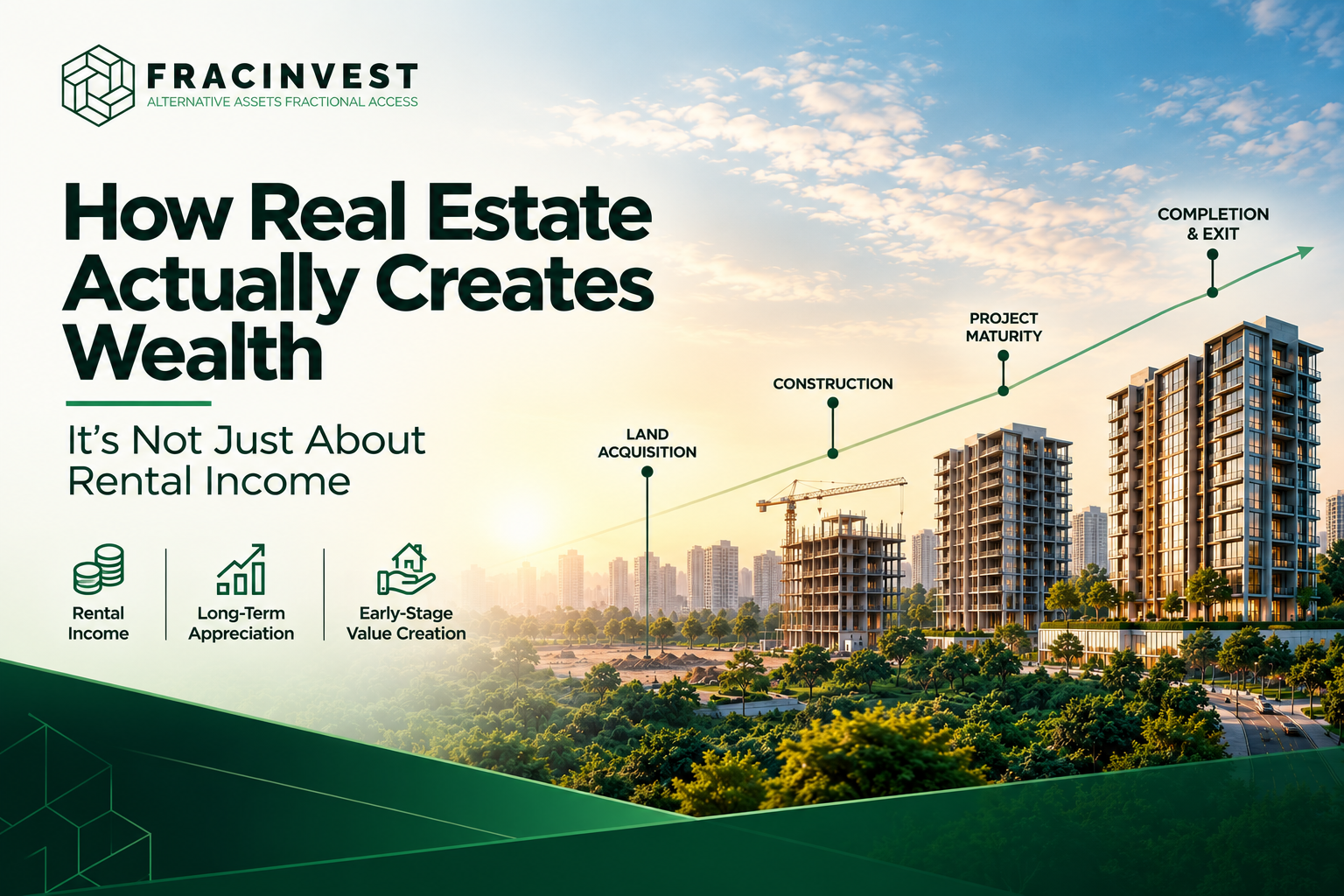
When people talk about making money from real estate, the conversation usually goes in two directions.
Buy a property and earn rent.
Or:
Buy a property and wait for it to appreciate.
Both are valid strategies. But there is a third approach that doesn't get discussed enough: entering a real estate project earlier in its development cycle, when there may still be value left to be created.
At FracInvest, this is the part of real estate we find particularly interesting.
Three Ways Real Estate Can Create Wealth
Think about a residential property worth ₹1 crore.
One investor buys the completed apartment and earns rent.
Another buys it and holds for 10 years, expecting the location and property to appreciate.
A third enters the project much earlier and looks to exit as the project moves towards a more mature stage.
All three own exposure to real estate, but their return drivers are very different.
Rental Income -> Long-Term Appreciation -> Early-Stage Value Creation
1. Rental Income
This is the most familiar strategy.
Suppose you buy an apartment for ₹1 crore and receive ₹35,000 per month in rent. That's ₹4.2 lakh annually or approximately 4.2% gross rental yield before maintenance, vacancy, property tax and other expenses.
The investor can also benefit from long-term property appreciation.
It's a straightforward strategy, particularly for someone looking for recurring income.
2. Long-Term Capital Appreciation
The second approach is simple: buy in a good location and hold.
As employment grows, infrastructure improves and housing demand increases, property values can appreciate.
But appreciation isn't automatic.
The micro-market, developer, infrastructure, supply and demand all matter.
And perhaps most importantly: At what price did you enter?
A great location can still become an average investment if you enter at the wrong valuation.
3. Early-Stage Value Creation
This is where real estate becomes more interesting from an investment perspective.
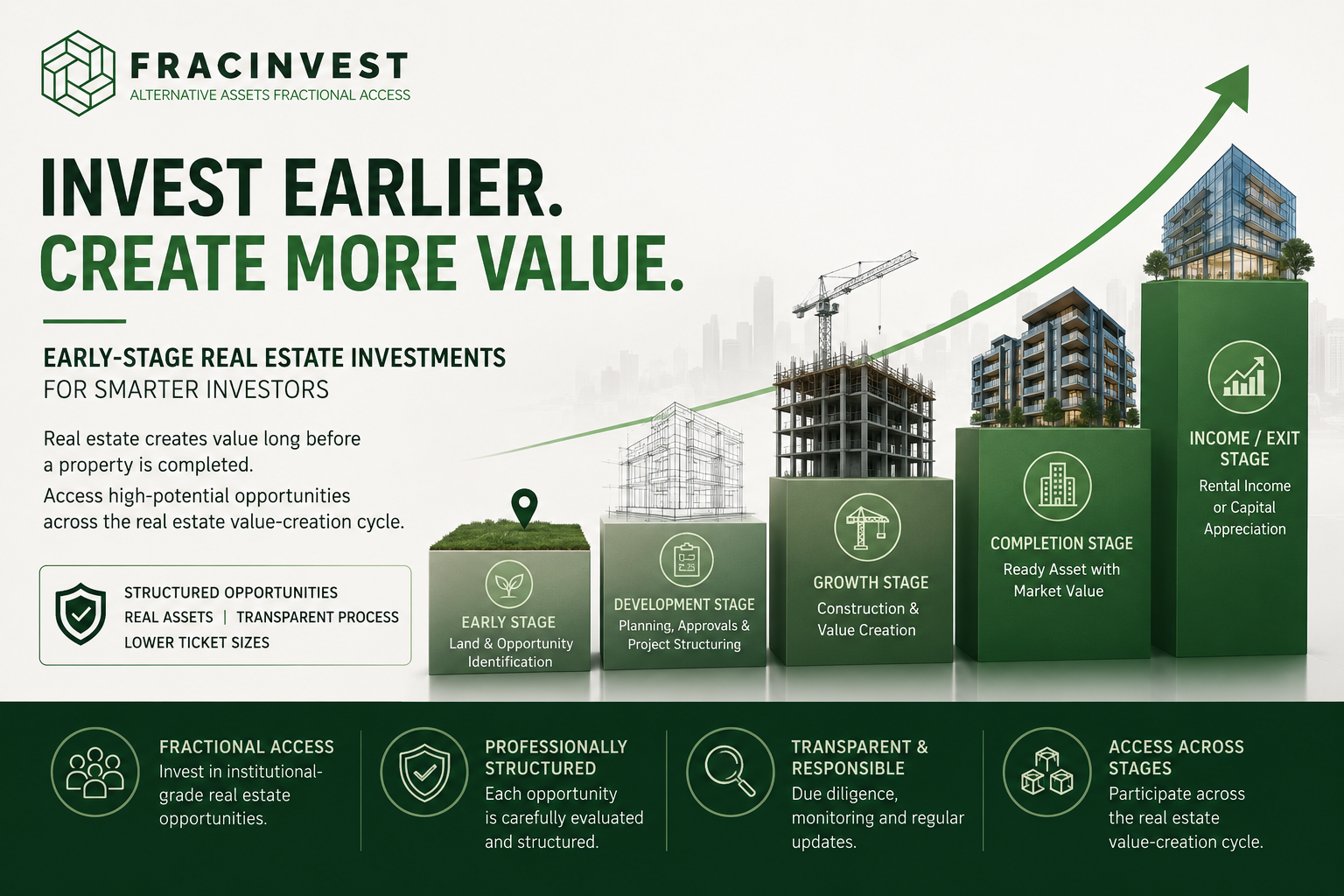
A project moves through several stages:
Launch -> Construction -> Project Maturity -> Completion
As construction progresses, uncertainty can reduce, the surrounding infrastructure can improve and the project can become more established.
The project's valuation may change along the way.
For example, if an investor enters at ₹8,000 per sq. ft. during an early stage and comparable market pricing later moves towards ₹10,000 per sq. ft., part of the potential value creation has happened during the development cycle itself.
That doesn't mean every early-stage project will appreciate.
It simply means the stage and valuation at which you enter can be an important source of return.
How the Three Strategies Compare
| Rental Property | Long-Term Property | Early-Stage Structured Real Estate | |
|---|---|---|---|
| Primary objective | Rental income | Capital appreciation | Development-stage value creation |
| Typical entry | Completed property | Completed/developing property | Earlier project stage |
| Capital requirement | Usually high | Usually high | Fractional participation can lower entry |
| Holding period | Usually long term | Usually long term | Can have a predefined tenure |
| Exit | Open-market sale | Open-market sale | Intended exit can be structured upfront |
| Main return driver | Rent + appreciation | Property appreciation | Entry valuation + project progress + exit |
| Key risks | Vacancy, market price | Market & liquidity | Developer, project, execution & exit |
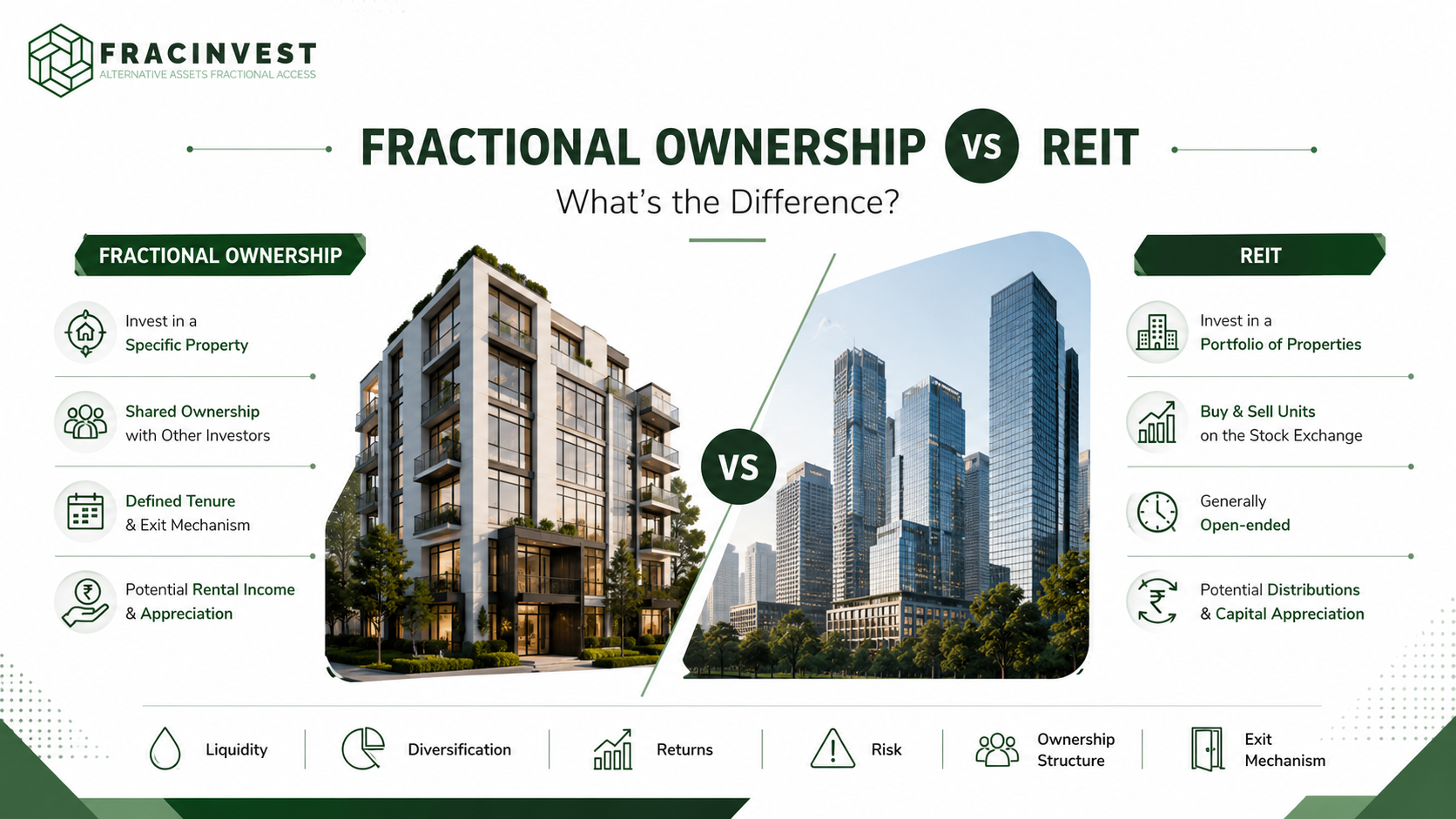
There isn't necessarily a winner here. These are simply different ways of participating in real estate.
Why Entry Price Matters
Let's take a simple example.
Suppose comparable properties indicate a reference market value of around ₹10,000 per sq. ft.
If you enter at ₹9,800, there isn't much valuation cushion.
But if a structured transaction allows entry at ₹8,000, you're entering approximately 20% below that reference price.
That doesn't guarantee a 20% return. Market prices can stagnate, projects can be delayed and developers can face financial difficulties.
But an attractive entry valuation can provide something important: a margin between your acquisition price and the prevailing reference value.
At FracInvest, that's where we prefer to start.
Not with:
"What return can this generate?"
But with:
"What are we buying, where are we entering, and why does this entry valuation make sense?"
The Problem: Good Real Estate Requires Significant Capital
This is where individual investors often face a practical problem.
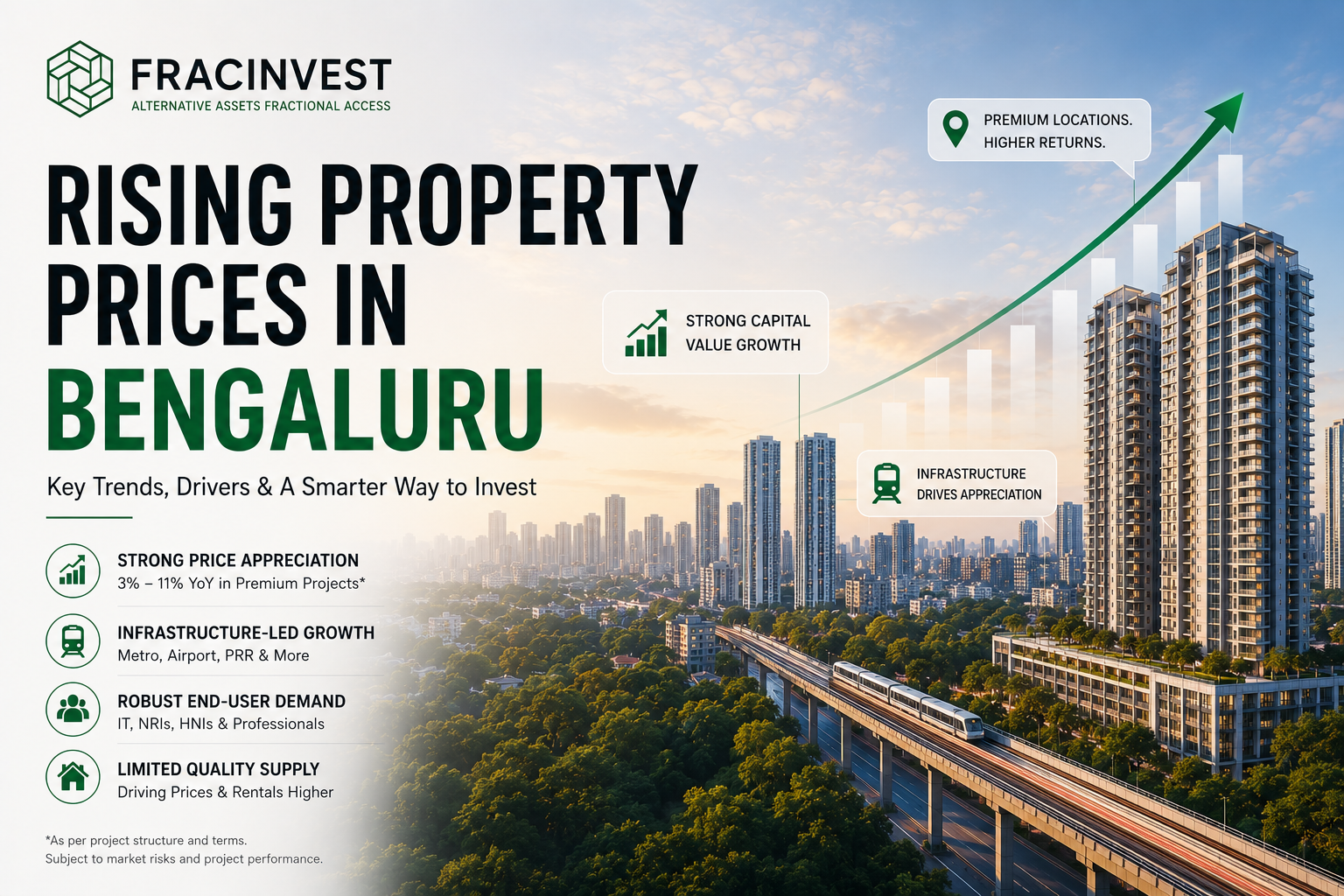
You may identify an attractive early-stage residential project in Whitefield, Sarjapur or another growing Bangalore corridor.
But purchasing an entire apartment could require ₹1 crore or more.
Putting that much money into one property creates concentration.
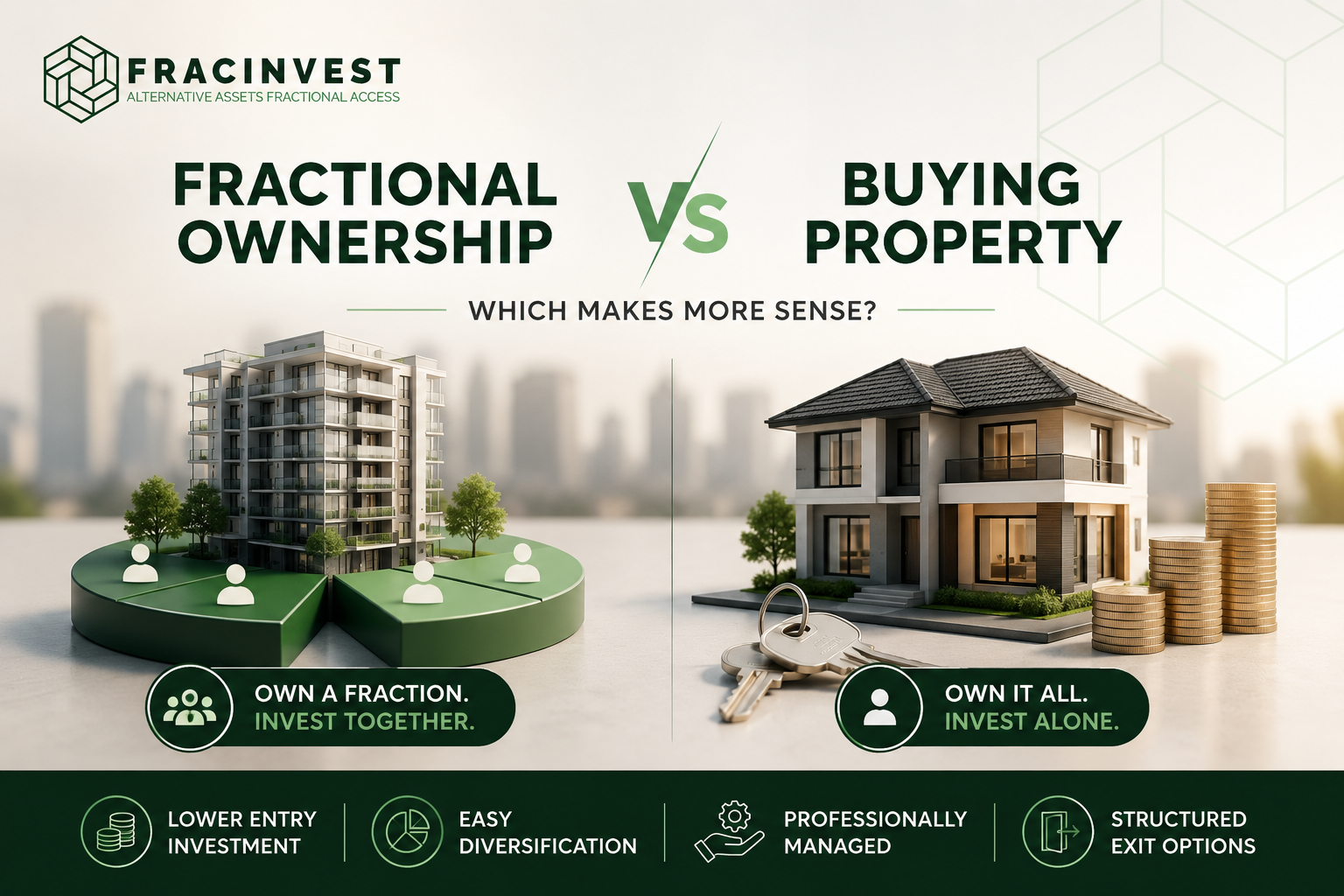
This is where fractional participation changes the equation.
What If You Could Participate From ₹20 Lakh?
At FracInvest, selected structured real estate opportunities can be accessed from ₹20 lakh onwards, without requiring an individual participant to purchase an entire residential unit.
But lowering the ticket size is only one part of the proposition.
We look at the complete transaction:
Underlying Asset -> Entry Valuation -> Developer -> Structure -> Security -> Holding Period -> Exit
The idea is to make selected early-stage opportunities accessible while evaluating how the investment is expected to work from entry to exit.
Early Entry Is Only Half the Story
One of the biggest challenges with traditional real estate is liquidity.
Most property transactions work like this:
Buy -> Hold -> Wait for Appreciation -> Find a Buyer -> Negotiate -> Exit
The exit is usually considered much later.
Structured opportunities can approach this differently:
Early-Stage Entry -> Defined Holding Period -> Intended Exit Mechanism
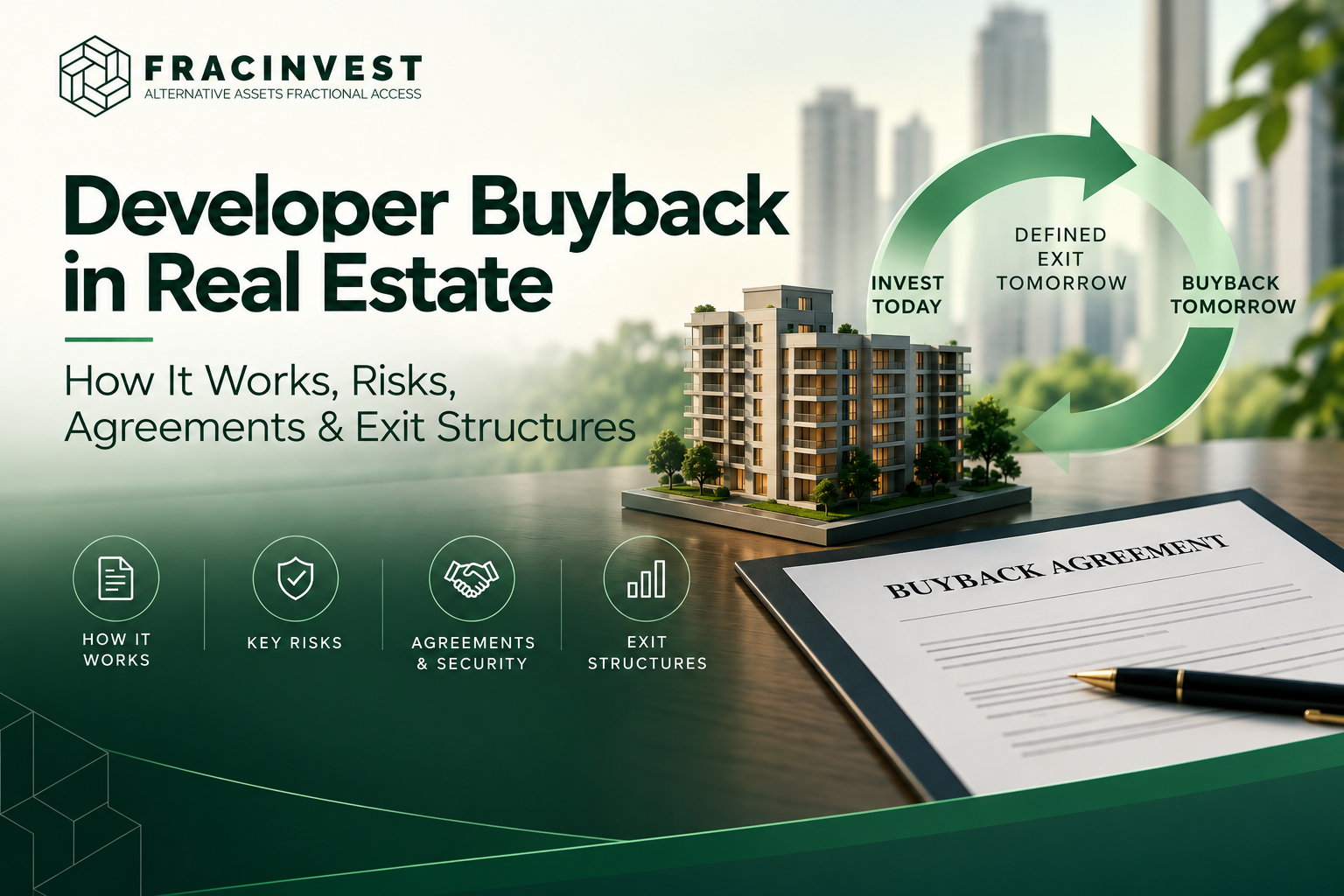
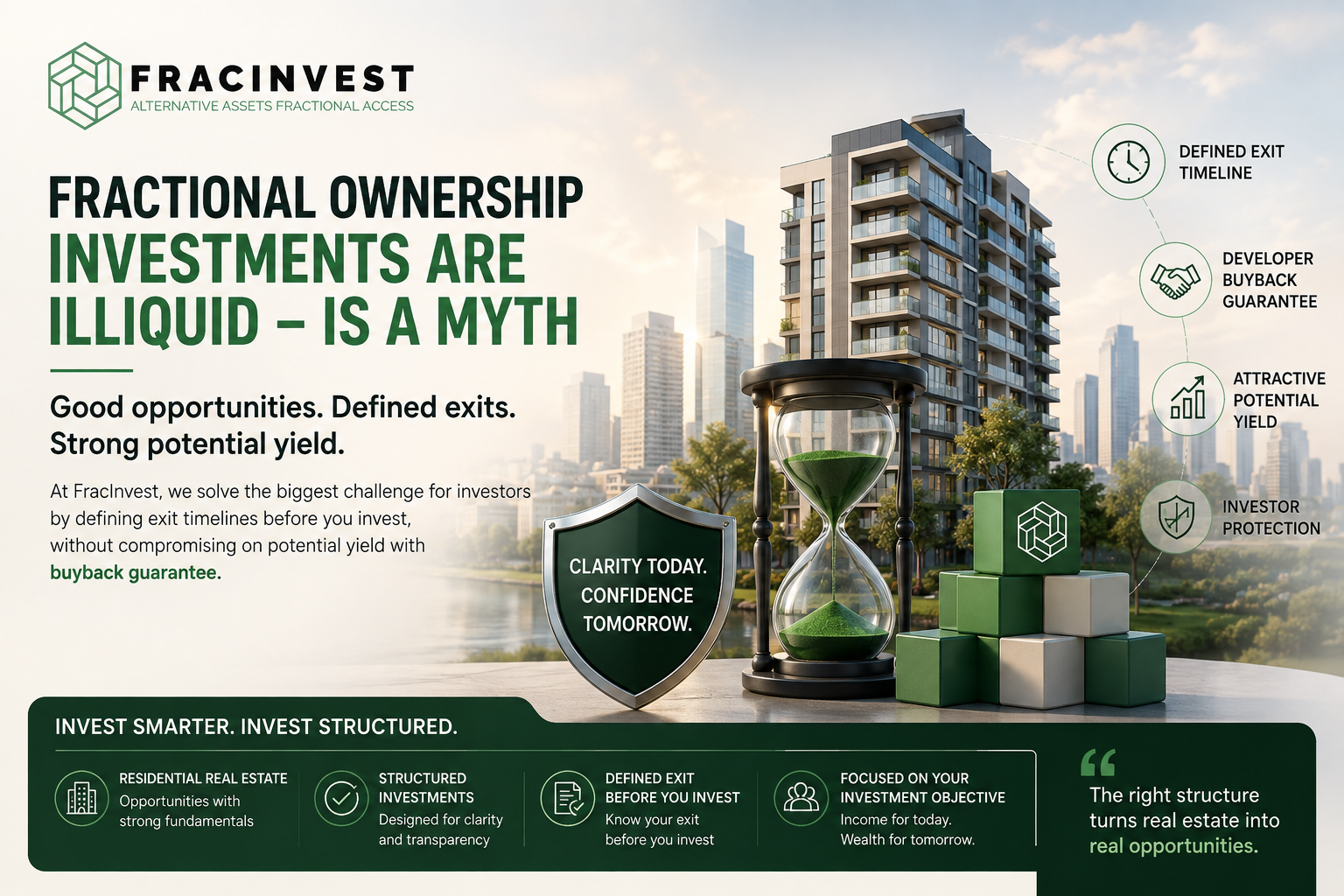
For example, selected opportunities may have a contractual developer buyback forming part of the intended exit structure.
This doesn't make the exit guaranteed.
The developer still needs the financial capacity to honour the obligation, and investors need to understand the agreement, underlying security and remedies if the planned exit doesn't happen.
But there is a meaningful difference between hoping to find a buyer in the future and evaluating the intended exit before entering the transaction.
Return Matters. Structure Matters More.
Early-stage real estate can potentially offer attractive returns because investors are taking risks that may not exist to the same extent in a completed property.
That makes due diligence critical.
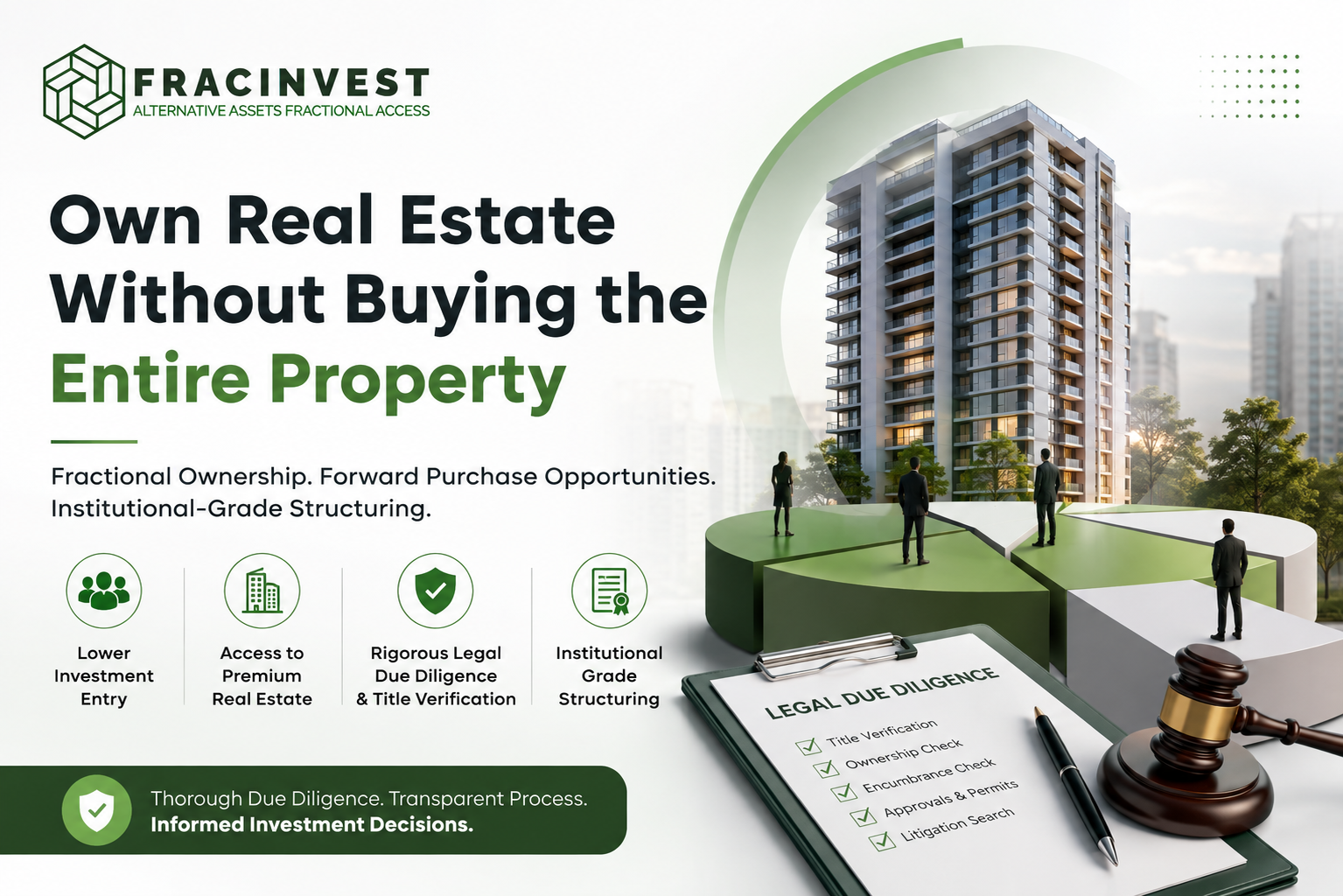
Before participating, we believe investors should understand four things:
The Asset: Is the underlying project fundamentally strong?
The Developer: What is their execution history and financial position?
The Entry: Are you genuinely entering at an attractive valuation?
The Exit: How is liquidity expected to be created, and what happens if the planned exit doesn't occur?
A high projected return without satisfactory answers to these questions isn't necessarily an attractive opportunity.
So, How Does Real Estate Actually Create Wealth?
Real estate can create wealth because you earn rent from it.
It can create wealth because the property appreciates over time.
And it can create wealth because you entered before part of that value was created.
That third approach is where FracInvest is focusing.
Selected early-stage real estate opportunities, evaluated around the underlying property, entry valuation, developer quality, investment structure, security and intended exit, with participation starting from ₹20 lakh onwards.
Because when you're looking at real estate purely as an investment, the question isn't only:
"Which property should I buy?"
Sometimes the more important question is:
"At what stage of the property's value-creation cycle should I enter?"
That can make a significant difference to how you think about real estate investing.
Disclaimer: This article is for educational purposes only and does not constitute investment, legal, tax or financial advice. Early-stage and fractional real estate opportunities involve developer, construction, market, liquidity, legal and execution risks. A predefined or contractual exit mechanism does not guarantee liquidity or returns. Investors should independently evaluate the underlying property, developer, documentation, structure and associated risks before participating.