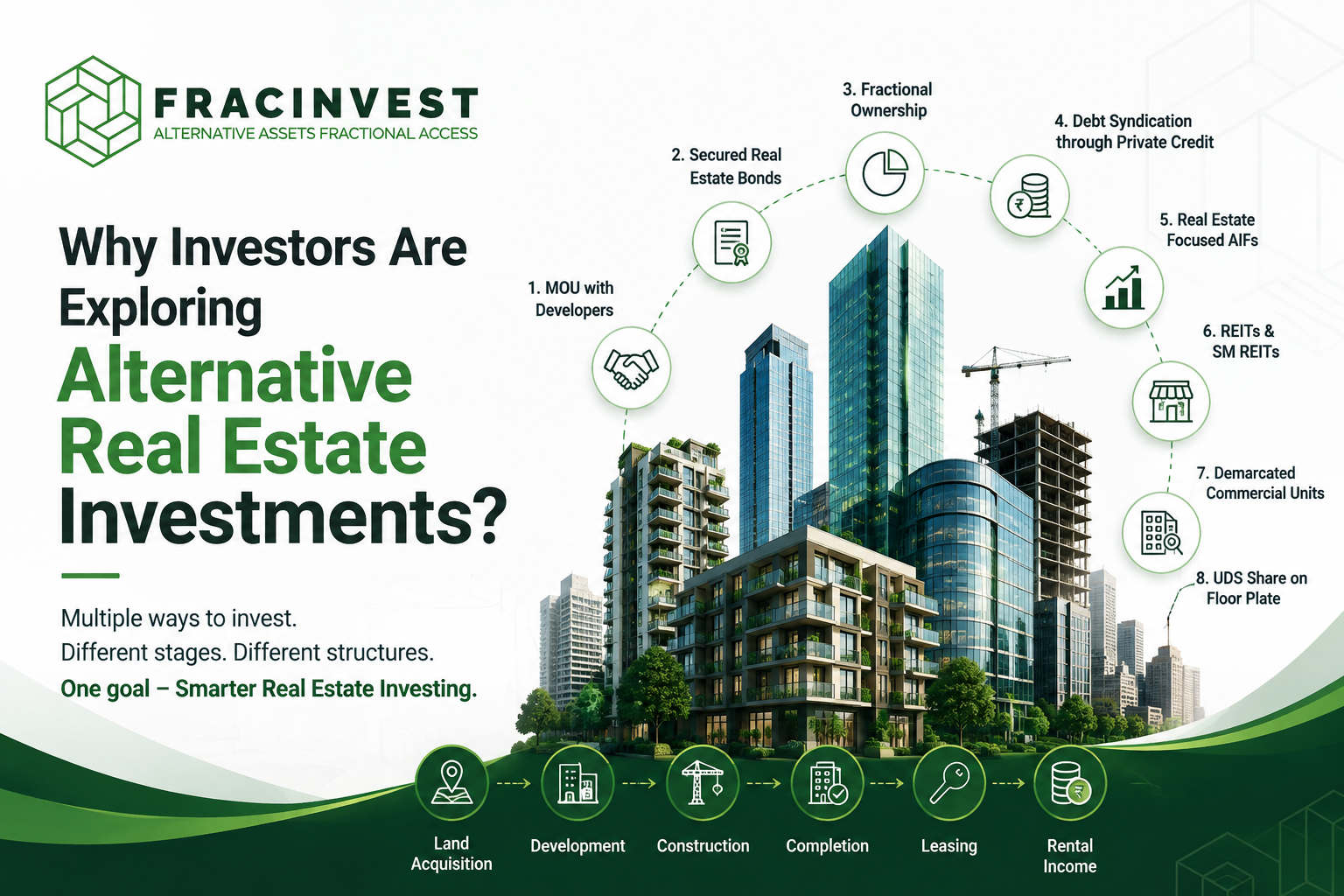
Real estate has traditionally been associated with buying a residential property, commercial property, plot or land and holding it for long-term appreciation.
But real estate investing is evolving.
Today, investors have multiple ways to participate in the real estate market without necessarily purchasing an entire property. From land-stage investments and secured real estate bonds to fractional ownership, private credit, AIFs, REITs and SM REITs, investors can choose investment structures based on their preferred risk, return, tenure, liquidity and ownership objectives.
This evolution has created a broader category of alternative real estate investments.
Instead of simply asking:
"Which property should I buy?"
Investors are increasingly asking:
"At which stage of the real estate lifecycle should I invest, and through which investment structure?"
What Are Alternative Real Estate Investments?
Alternative real estate investments are investment structures that provide investors with exposure to real estate without relying solely on traditional outright property ownership.
An investor can participate in real estate through:
- Equity or development-stage investments
- Structured real estate debt
- Secured real estate bonds
- Fractional ownership
- Private credit
- Real estate-focused AIFs
- REITs and SM REITs
- Direct commercial real estate ownership
Each structure provides a different combination of risk, return potential, liquidity, investment tenure and ownership rights.
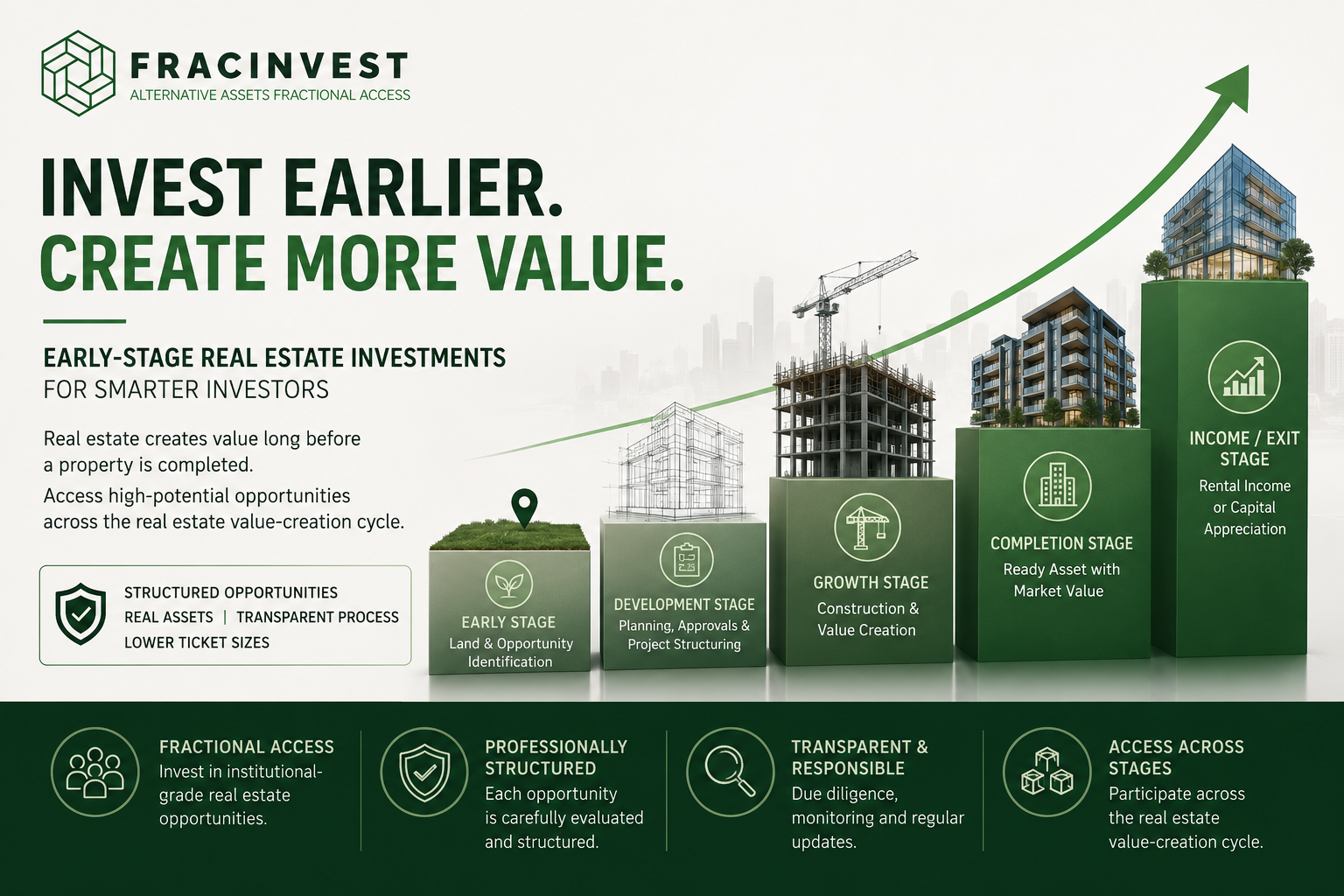
The real estate lifecycle can broadly be represented as:
Land Acquisition -> Development -> Construction -> Completion -> Leasing -> Rental Income -> Exit
The stage at which an investor enters can significantly influence the investment characteristics.
8 Ways to Invest in Real Estate in India
1. MOU With Developers at the Land Acquisition Stage
One of the earliest ways to participate in a real estate opportunity is through an MOU or structured agreement with a developer at the land acquisition or pre-development stage.
This represents an early-stage approach to real estate investing.
At this point, the project may still be in the process of acquiring land, obtaining approvals or structuring the development.
Why can the potential return be higher?
Early-stage investors are participating closer to the beginning of the real estate value creation cycle.
If the developer successfully acquires the land, obtains approvals and develops the project, the value of the opportunity can potentially increase significantly.
However, early entry also means exposure to greater uncertainty.
Potential risks can include:
- Land acquisition risk
- Title-related issues
- Approval risk
- Development risk
- Funding risk
- Execution risk
- Market risk
- Developer risk
- Longer investment timelines
Therefore, land-stage investment opportunities can offer higher potential returns along with higher development and execution risk.
2. Secured Real Estate Bonds With Defined Coupon and Tenure
Secured real estate bonds represent another way of gaining exposure to the real estate sector.
Instead of investing directly for property appreciation, investors participate in a structured debt investment where the investment may have a defined coupon, tenure and security mechanism.
Depending on the specific structure, terms may include:
- Principal investment
- Coupon or interest rate
- Fixed investment tenure
- Repayment schedule
- Security or collateral
- Defined use of funds
- Repayment or exit mechanism
The investment thesis is therefore different from traditional property ownership.
Instead of depending primarily on the appreciation of a property, the investor's expected return is linked to the contractual debt obligation and repayment structure.
For investors looking for structured real estate investments with a defined tenure and coupon, secured real estate bonds can be an alternative to conventional property ownership.
3. Fractional Ownership in Real Estate
Fractional ownership has emerged as another alternative way to participate in real estate.
Under a fractional ownership structure, multiple investors participate in the ownership or economic interest of an underlying property through an appropriate legal structure.
This can potentially provide investors access to real estate assets without requiring one investor to acquire the entire property.
Why is fractional real estate investment gaining attention?
Fractional ownership can potentially provide:
- Lower investment ticket compared with outright property ownership
- Access to larger real estate assets
- Diversification
- Professional asset management
- Potential rental income
- Potential capital appreciation
- Structured investment tenure
- Access to selected real estate opportunities
One particularly interesting segment is fractional ownership during the early construction phase.
At this stage, the investor enters after the project has moved beyond the initial land acquisition stage but before the property becomes a fully operational, income-generating asset.
This can provide an alternative approach to participating in the real estate development cycle.
Fractional Ownership Through FracInvest
FracInvest is positioned around providing investors access to structured fractional real estate investment opportunities.
The objective is to make selected real estate opportunities accessible through structured investment models while focusing on factors such as the underlying asset, investment structure, potential returns and defined exit mechanisms.
4. Private Credit and Real Estate Debt Syndication
Real estate developers require capital throughout the development cycle.
Funding may be required for:
- Land acquisition
- Construction
- Project completion
- Inventory acquisition
- Refinancing
- Working capital
This creates opportunities for private credit and real estate debt syndication.
Instead of purchasing a property, investors provide capital to a developer or borrower through a structured debt arrangement.
The structure may include:
- Fixed interest
- Defined tenure
- Security
- Repayment schedule
- Escrow arrangements
- Covenants
- Project-level cash flow controls
Private credit can potentially provide investors with attractive returns, but the investment outcome depends on the underlying borrower, project, collateral, repayment source and legal structure.
For investors, the key distinction is that private credit provides financial exposure to the real estate project rather than direct ownership of the property.
5. Real Estate-Focused AIFs
A Real Estate AIF provides investors with another route to participate in the real estate market.
Alternative Investment Funds pool capital from investors and deploy it according to a defined investment strategy.
Depending on the fund mandate, a real estate AIF may invest in:
- Residential projects
- Commercial real estate
- Development opportunities
- Real estate debt
- Structured transactions
- Special situations
- Distressed real estate assets
For investors, one potential advantage is professional fund management.
Rather than selecting individual properties themselves, investors participate in a professionally managed investment vehicle.
However, AIFs can have higher investment thresholds, longer investment horizons and limited liquidity depending on their structure.
6. REITs and SM REITs
For investors looking for exposure to income-generating commercial real estate, REITs and SM REITs provide another investment route.
A Real Estate Investment Trust (REIT) allows investors to participate in a portfolio of eligible income-generating real estate assets.
These may include:
- Office buildings
- Business parks
- Retail assets
- Warehouses
- Other commercial properties
SM REITs provide another framework for fractional participation in eligible real estate assets, subject to applicable regulations.
The investment proposition is different from early-stage real estate development.
Here, the underlying property is generally closer to the income-generating stage of the real estate lifecycle.
The investment thesis can therefore focus more on rental income and the value of operational commercial assets.
Listed REITs can also provide greater liquidity than many privately structured real estate investments because their units can trade on an exchange.
7. Demarcated Commercial Real Estate Units
Another way to invest in real estate is through the purchase of an identified commercial real estate unit.
Developers may offer:
- Retail shops
- Office spaces
- Showrooms
- Commercial suites
- Food and beverage spaces
The investor purchases a specific unit and can potentially generate returns through:
Rental Income + Capital Appreciation
This is closer to traditional real estate ownership, although the investment is focused on commercial property.
Commercial real estate investments can potentially offer attractive rental yields, but performance depends on factors such as:
- Location
- Tenant demand
- Rental rates
- Occupancy
- Lease terms
- Maintenance costs
- Developer quality
- Resale demand
8. Commercial Real Estate With UDS Share
Some developers structure commercial real estate investments differently by providing investors with an Undivided Share (UDS) in the underlying land or property.
UDS represents an undivided proportionate interest in the underlying land rather than a physically demarcated portion of land.
This can be different from purchasing a clearly identified commercial unit.
For example, investors may come across structures where they are offered:
Demarcated Commercial Unit
versus
UDS Share Associated With the Commercial Property
The legal and economic rights can differ depending on the specific structure and documentation.
Therefore, investors should understand whether they are acquiring:
- A specific commercial unit
- An undivided share in land
- An interest through an SPV
- A beneficial interest
- Another contractual investment interest
This distinction is particularly important when evaluating commercial real estate investment opportunities.
Alternative Real Estate Investment Options Compared
| Investment Route | Entry Stage | Potential Return Driver | Typical Risk Profile | Liquidity |
|---|---|---|---|---|
| Developer MOU | Land Acquisition | Value Creation / Appreciation | Higher | Low |
| Secured Real Estate Bonds | Development / Funding | Coupon / Interest | Moderate to High | Low |
| Fractional Ownership | Construction / Development | Appreciation + Income | Moderate | Structure Dependent |
| Private Credit | Development / Funding | Interest / Coupon | Moderate to High | Low |
| Real Estate AIF | Multiple Stages | Fund Strategy | Moderate to High | Usually Limited |
| REIT | Income Generating | Rental Income + Market Value | Moderate | Higher for Listed REITs |
| SM REIT | Income Generating | Rental Income + Asset Value | Structure Dependent | Structure Dependent |
| Commercial Unit | Development / Completed | Rental Income + Appreciation | Asset Specific | Moderate to Low |
| UDS-Based Investment | Development / Completed | Income + Appreciation | Structure Dependent | Structure Dependent |
Actual risk, return, liquidity and investment characteristics vary by opportunity and legal structure.
Which Real Estate Investment Is Right for You?
There is no single best real estate investment for every investor.
The appropriate structure depends on factors such as:
- Investment capital
- Risk appetite
- Investment horizon
- Liquidity requirements
- Expected return profile
- Income requirements
- Capital appreciation objectives
- Ownership preference
- Diversification requirements
An investor looking for early-stage value creation may explore land-stage opportunities.
An investor seeking a defined coupon and tenure may consider structured real estate debt or secured real estate bonds.
An investor seeking fractional access to real estate may consider fractional ownership.
An investor looking for professionally managed exposure may consider a real estate AIF.
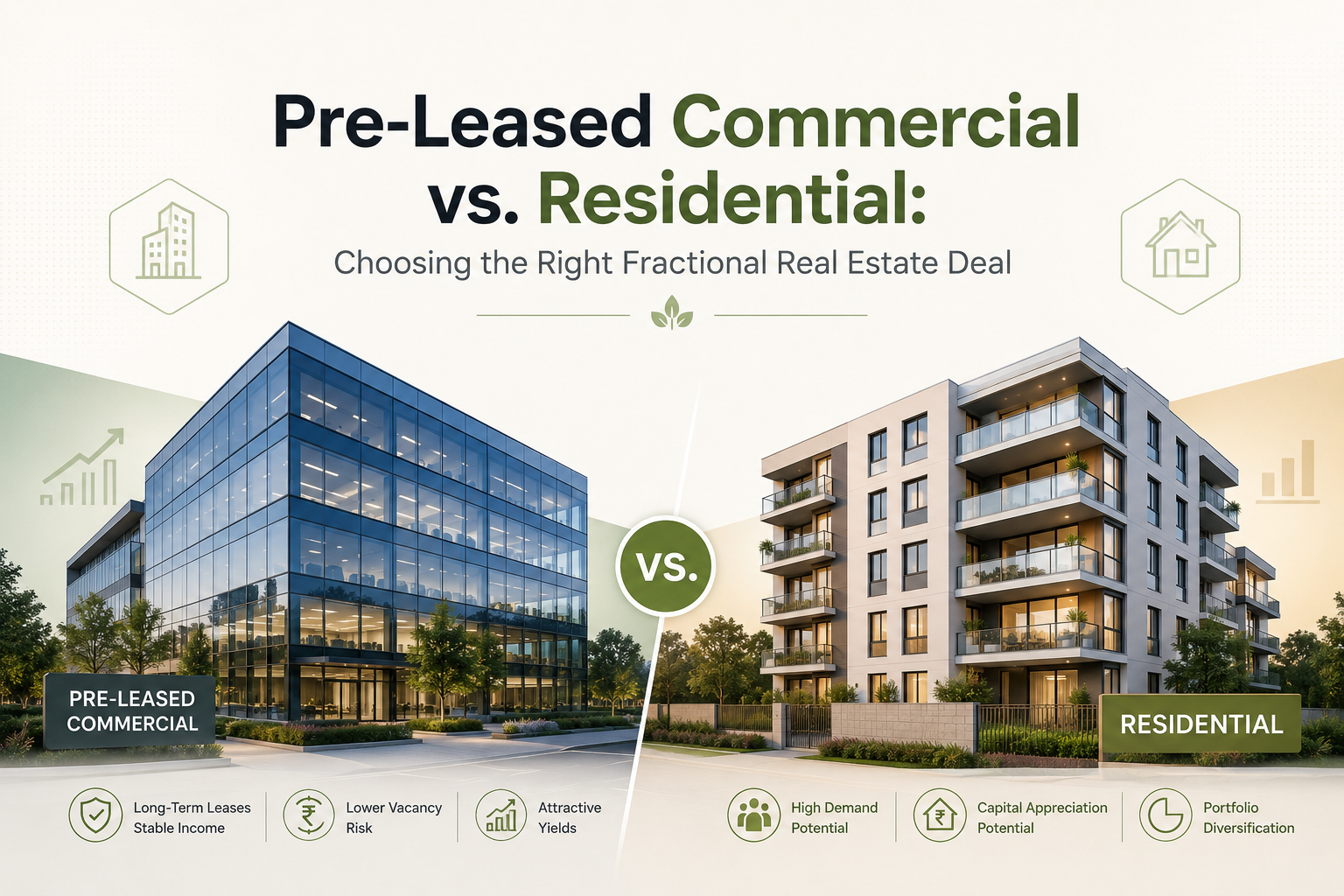
And investors seeking exposure to income-generating commercial real estate may explore REITs, SM REITs or direct commercial property.
Why Are Investors Exploring Alternative Real Estate Investments?
The growing interest in alternative real estate investment is being driven by a fundamental change in how investors think about property.
Lower Capital Requirement
Buying an entire property can require substantial capital.
Structured investment models can potentially allow investors to participate in larger real estate opportunities with a comparatively lower investment ticket.
More Investment Choices
Investors can choose between equity, debt, fractional ownership, income-generating assets and fund-based structures.
Different Risk-Return Profiles
Real estate investments can be structured across different stages of the property lifecycle.
An investor can potentially choose between:
Higher Development Risk -> Higher Potential Upside
and
Income-Generating Assets -> Greater Focus on Cash Flow
depending on their investment objective.
Defined Investment Structures
Modern investors increasingly want greater clarity around:
Investment -> Structure -> Return -> Tenure -> Exit
This has contributed to growing interest in structured real estate investments.
Access to Alternative Assets
Investment structures such as fractional ownership, private credit and AIFs can potentially provide investors access to opportunities that were historically more accessible to institutional investors, family offices and high-net-worth investors.
The Future of Real Estate Investing
Real estate investing is no longer limited to buying a property and waiting for its value to appreciate.
Investors can now participate at different points of the real estate lifecycle.
Land Acquisition -> Development -> Construction -> Completion -> Leasing -> Rental Income
And they can choose from multiple investment structures:
Developer MOU -> Real Estate Bonds -> Fractional Ownership -> Private Credit -> AIFs -> REITs -> SM REITs -> Commercial Real Estate
This evolution is creating a broader ecosystem of alternative real estate investments in India.
The key is understanding the investment structure and choosing an opportunity that aligns with the investor's objectives, risk appetite, investment horizon and liquidity requirements.
How FracInvest Fits Into Alternative Real Estate Investing
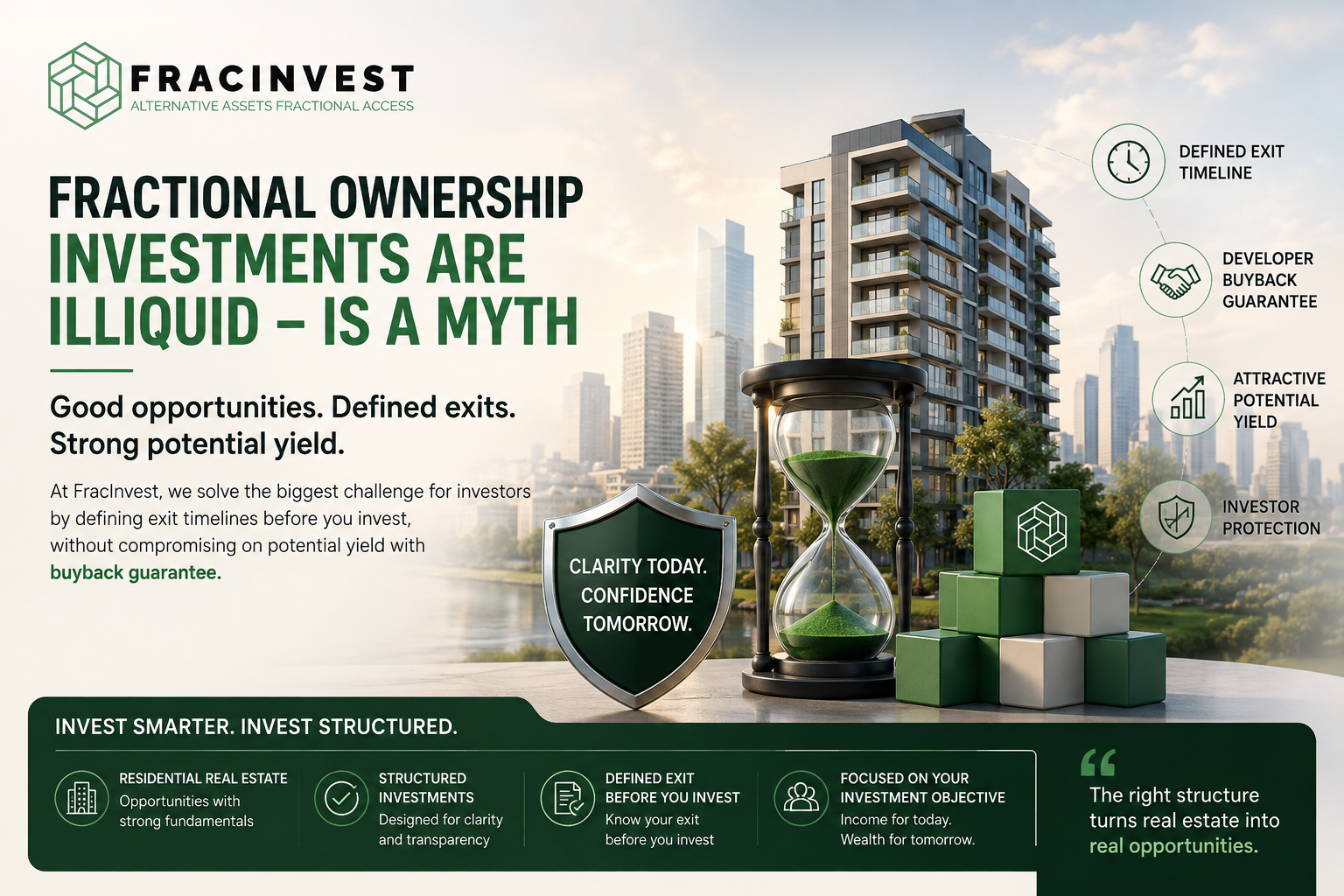
At FracInvest, our focus is on creating access to structured real estate investment opportunities through fractional ownership and other alternative real estate investment structures.
The objective is to bridge the gap between traditional property ownership and sophisticated real estate investment opportunities by focusing on:
Institutional-Grade Opportunities Structured Investment Models Fractional Access Defined Investment Horizons Potential High-Yield Opportunities Defined Exit Mechanisms
For investors looking beyond traditional property ownership, alternative real estate investing can provide a different way to participate in the growth and value creation of the real estate sector.
The future of real estate investing may not simply be about owning an entire property.
It may be about accessing the right real estate opportunity, at the right stage, through the right structure.
FAQs: Alternative Real Estate Investments
What are alternative real estate investments?
Alternative real estate investments are investment structures that provide exposure to real estate beyond traditional outright property ownership. These can include fractional ownership, real estate bonds, private credit, AIFs, REITs, SM REITs and structured real estate investments.
What are the different ways to invest in real estate?
Investors can participate in real estate through land-stage agreements with developers, secured real estate bonds, fractional ownership, private credit, real estate AIFs, REITs, SM REITs, commercial real estate units and UDS-based structures.
What is fractional ownership in real estate?
Fractional ownership allows multiple investors to participate in the ownership or economic interest of a real estate asset through an appropriate legal structure rather than one investor acquiring the entire property.
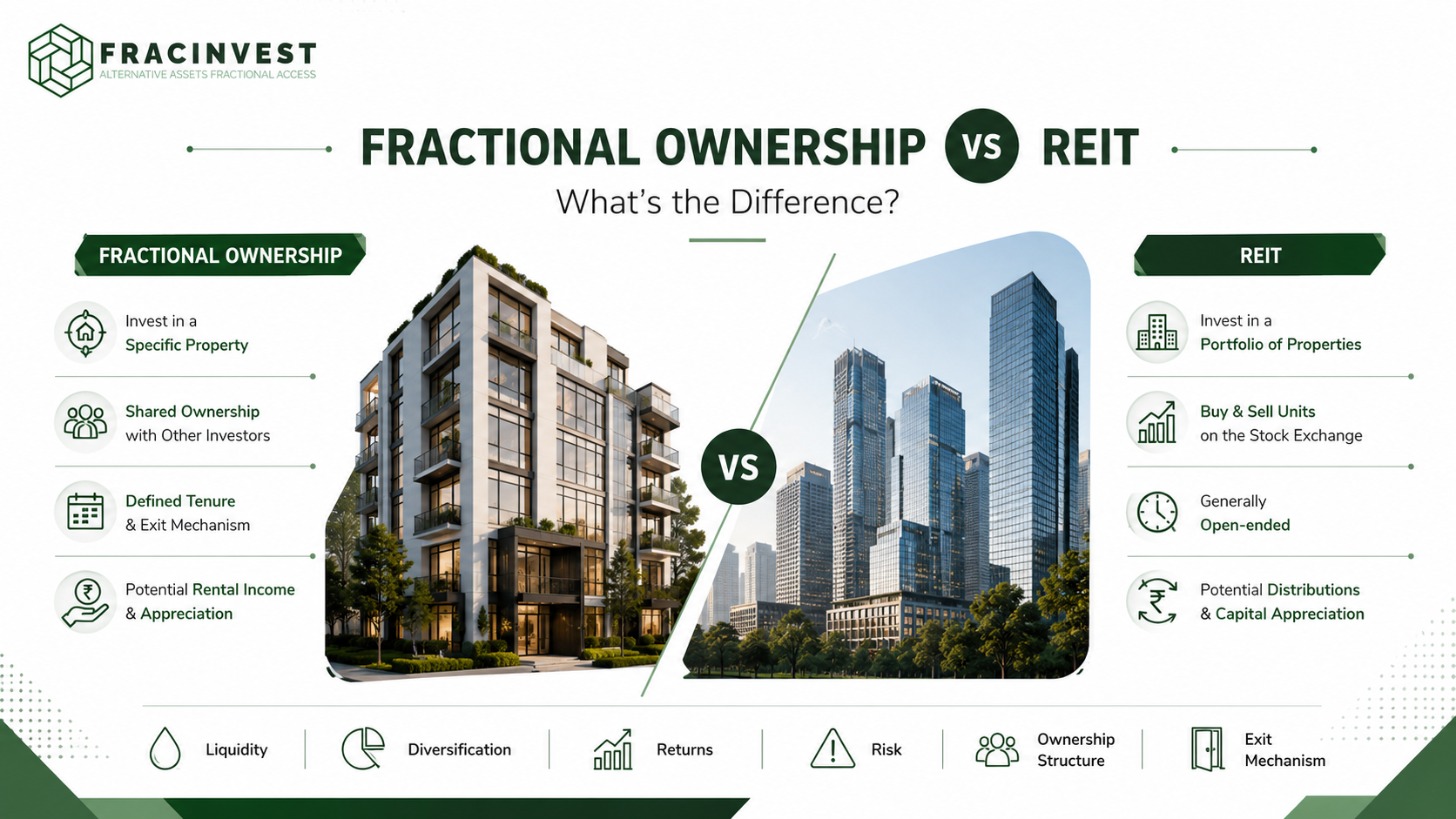
Are fractional real estate investments different from REITs?
Yes. Fractional ownership and REITs have different ownership, regulatory, liquidity and investment structures. Fractional ownership can provide exposure to a specific underlying asset or portfolio depending on its structure, while a REIT is a regulated vehicle that owns or invests in eligible income-generating real estate assets.
What are secured real estate bonds?
Secured real estate bonds are structured debt investments that may provide a defined coupon and tenure and may be backed by specified security, depending on the terms and legal structure of the investment.
What is private credit in real estate?
Real estate private credit involves providing debt capital to developers or real estate businesses through structured financing arrangements, generally in exchange for interest or another agreed return.
What are SM REITs?
SM REITs are Small and Medium Real Estate Investment Trusts that provide a regulated framework for investment in eligible real estate assets, subject to applicable regulations.
Is alternative real estate investing risky?
Yes. Different alternative real estate investments carry different risks. Development-stage investments may have higher execution and market risks, while debt investments involve borrower and repayment risk. Liquidity also varies significantly between investment structures.