
"Is fractional ownership of real estate legal in India?"
It is probably one of the first questions someone asks when they come across a fractional real estate opportunity.
And it is a fair question.
When you buy a flat traditionally, things feel familiar. There is a buyer, a seller, a sale agreement and a property registered in someone's name.
Fractional ownership works differently because several people participate in the same real estate opportunity through a structured mechanism.
So, is it legal?
Yes, fractional ownership of real estate can be legally structured in India. But not every fractional ownership model works under the same regulatory framework.
That distinction is important.
Today, an investor looking for fractional exposure to real estate may come across three broad models:
- Listed REITs
- SEBI-regulated SM REITs
- Traditional SPV-based fractional ownership structures
They may all provide exposure to real estate, but legally and structurally they are quite different.
Let's understand them without making it unnecessarily complicated.
1. REITs: The Listed and Regulated Route
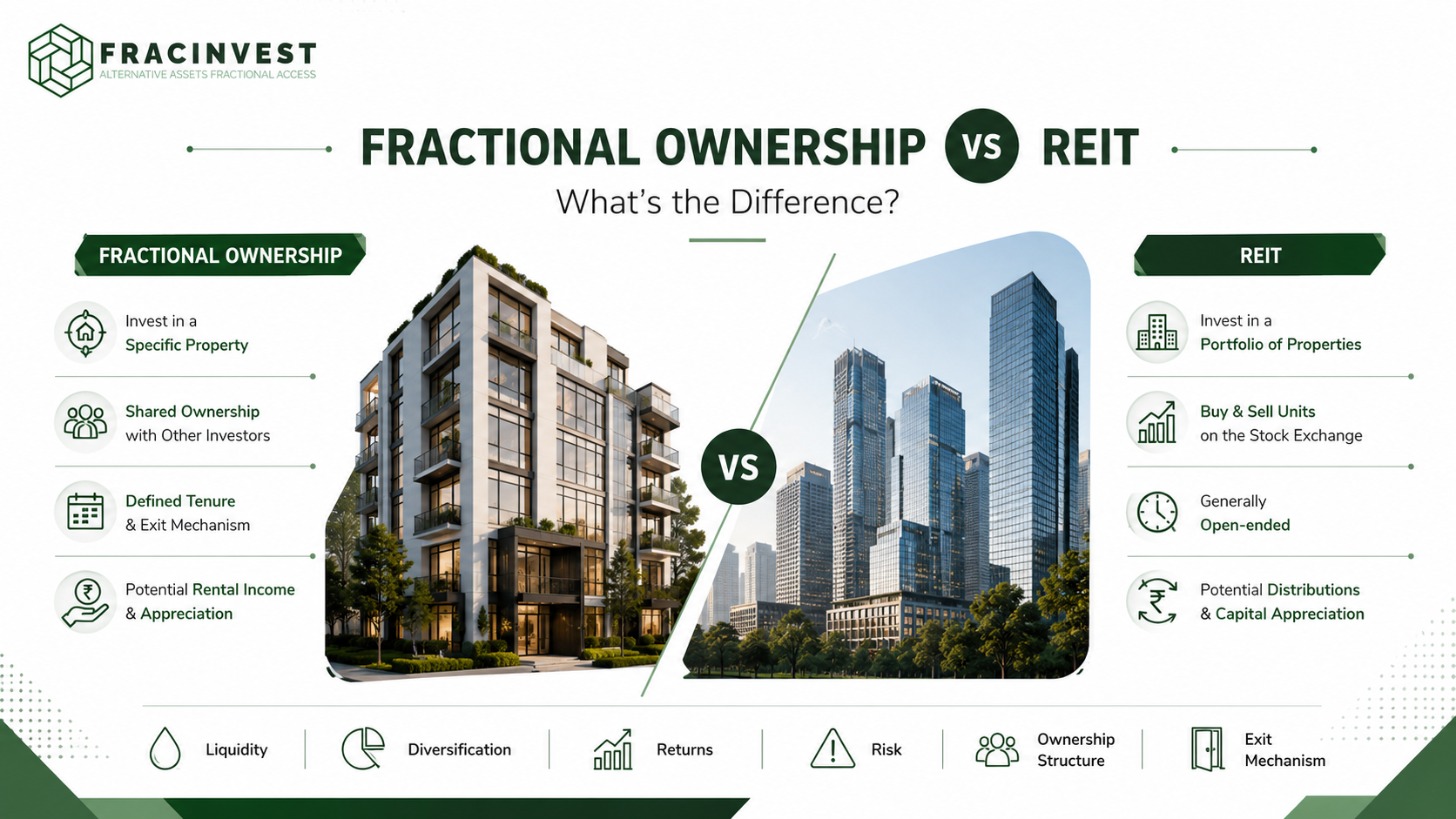
A Real Estate Investment Trust or REIT allows investors to participate in a portfolio of income-generating real estate without purchasing those properties directly.
REITs in India operate under the SEBI (Real Estate Investment Trusts) Regulations, 2014.
Think of a REIT somewhat like investing in a professionally managed real estate portfolio.
You purchase units of the REIT rather than purchasing a fraction of one apartment or office directly.
For an investor, one of the biggest advantages is regulation.
The structure, manager, trustee, disclosures, investments and other requirements are governed by SEBI's REIT framework.
REIT units can also provide liquidity through recognised stock exchanges, subject to market conditions.
But there is a trade-off.
You are generally investing in a larger portfolio rather than choosing one specific property that you personally want exposure to.
So REITs can make sense for investors who want regulated and relatively liquid real estate exposure without managing individual properties themselves.
2. SM REITs: Bringing Fractional Real Estate into a SEBI-Regulated Structure
This is where things get particularly interesting for fractional real estate in India.
As fractional ownership platforms grew, SEBI recognised that investors were increasingly participating in real estate through structures involving private limited companies and LLPs.
SEBI subsequently introduced the Small and Medium REIT or SM REIT framework under the REIT Regulations.
The idea is to provide a regulated framework for smaller real estate investment schemes.
Unlike traditional large REITs, an SM REIT can create separate schemes that own real estate assets through Special Purpose Vehicles, or SPVs, constituted as companies.
This makes the structure closer to the property-specific investing experience many fractional investors are familiar with.
An SM REIT is registered with SEBI and operates within requirements relating to matters such as the investment manager, trustee, disclosures, valuation, investor rights and the underlying assets.
For investors, that means the regulatory framework is clearly defined.
But there is another important point.
SM REITs are not simply another name for every fractional ownership opportunity in India.
Only structures meeting the applicable SEBI requirements and registered accordingly can represent themselves as SM REITs.
So if a platform offers fractional real estate through an SPV, that does not automatically make the opportunity an SM REIT.
3. Traditional SPV-Based Fractional Ownership
Now let's come to the model that existed well before SM REITs became part of India's regulatory landscape.
The SPV-based fractional ownership model.
SPV stands for Special Purpose Vehicle.
Instead of ten investors putting their names individually on the title deed of a property, a separate legal entity can be created specifically to hold or participate in the real estate investment.
Depending on the structure, that entity could be a company or an LLP.
The SPV then enters into the relevant property transaction.
Investors participate through the rights or interests created under that legal entity and the applicable agreements.
This distinction matters.
The property and the investor's interest in the SPV are two different layers of the structure.
Imagine a real estate opportunity requiring ₹10 crore.
Instead of one person investing the entire ₹10 crore, the opportunity could be structured through an SPV with multiple participants contributing capital.
The SPV uses that capital for the defined real estate transaction.
The legal agreements then determine matters such as:
- how much each participant contributes
- what economic rights they receive
- how profits or distributions are allocated
- who manages the SPV
- how major decisions are taken
- how the underlying property transaction is executed
- what happens at exit
- how proceeds are distributed
This is what people generally mean when they talk about a structured fractional real estate investment.
Is an SPV-Based Fractional Ownership Model Legal?
This is where the answer needs some nuance.
An SPV structure does not become illegal simply because it is not a REIT or SM REIT.
Companies and LLPs are recognised legal entities in India, and SPVs are commonly used across real estate and other industries to hold assets and undertake specific transactions.
In fact, while developing its regulatory framework for fractional real estate, SEBI itself observed that fractional ownership structures had typically been using private limited companies or LLPs.
But this should not be misunderstood to mean that every SPV-based fractional investment is automatically approved or regulated by SEBI.
It isn't.
The legality and robustness of a traditional fractional ownership structure depend on how the transaction has actually been structured and whether it complies with the laws applicable to that structure, fundraising mechanism, property and investor arrangement.
That is why documentation matters so much.
What Makes a Structured Fractional Investment Different?
Think of it this way.
If ten people simply transfer money to someone and are told, "Don't worry, you collectively own this property," there are obvious questions.
Who legally owns the property?
Where is the investors' money held?
What exactly does each investor own?
Who can operate the bank account?
Who decides when to sell?
What happens if the manager disappears?
What happens if one investor wants to exit?
A properly structured investment attempts to answer these questions before the money is invested.
The structure creates a legal chain connecting:
Investor -> Legal Entity/SPV -> Real Estate Transaction -> Exit -> Distribution
That chain is important.
The SPV Is Only One Part of the Protection
Creating an LLP or private limited company by itself does not make an investment safe.
The real strength comes from the entire structure around it.
For example, investors should understand:
Who owns the property?
The transaction documents should clearly establish who owns or has contractual rights over the underlying real estate.
What does the investor own?
An investor should know whether their participation is through shares, partnership interest, units or another legally documented economic interest.
Where does the money go?
There should be clarity around how investor capital is collected, held and deployed.
Who controls the SPV?
The constitutional documents and agreements should explain management rights, voting rights and decision-making.
How are returns distributed?
The mechanism for distributing income, profits or exit proceeds should be documented rather than based on a verbal promise.
How does the investor exit?
This is particularly important.
If an opportunity has a defined tenure or planned exit, the legal documents should explain how that exit is intended to work and what happens if the expected exit is delayed or does not occur.
These are the things that turn an investment from a simple marketing proposition into a structured transaction.
REIT vs SM REIT vs SPV Fractional Ownership
| Structure | REIT | SM REIT | Traditional SPV Model |
|---|---|---|---|
| Regulatory Framework | SEBI REIT Regulations | SEBI REIT Regulations | Depends on structure and applicable laws |
| SEBI Registered | Yes | Yes | Not automatically |
| Typical Structure | Trust with underlying assets/SPVs | Trust with scheme-level SPVs | Company or LLP SPV |
| Investor Participation | REIT units | Scheme units | Shares, partnership/economic interest depending on structure |
| Property Selection | Portfolio based | Scheme/property focused | Can be property or transaction specific |
| Exchange Liquidity | Listed structure | Subject to SM REIT framework | Usually not exchange traded |
| Legal Documentation | Standardised regulatory framework | Standardised regulatory framework | Transaction specific |
| Investor Due Diligence | Still required | Still required | Particularly important |
The biggest mistake would be to look at this table and conclude that one structure is automatically "better" than another.
They serve different purposes.
The more useful question is:
Do I understand exactly what I am investing in and what legal rights I receive?
Does SEBI's SM REIT Framework Make Traditional Fractional Ownership Illegal?
Not simply by its existence.
The introduction of SM REIT regulations created a specific regulated route for qualifying fractional real estate structures.
It does not mean that every company or LLP that owns real estate suddenly becomes an SM REIT.
At the same time, businesses raising money from investors cannot simply choose an SPV structure and assume that no securities, company, LLP, property, tax or other regulatory requirements apply.
The substance of the arrangement matters, not just the name given to it.
This is why investors should avoid assuming that terms such as "SPV", "fractional ownership", "structured investment" or "co-ownership" automatically tell them the regulatory status of an opportunity.
Ask for the actual structure.
Regulation and Legal Structuring Are Not the Same Thing
This is perhaps the most important takeaway from the entire discussion.
SEBI regulation and legal structuring are related concepts, but they are not the same thing.
A registered REIT or SM REIT operates under a dedicated SEBI regulatory framework.
A traditional SPV investment may instead rely on an appropriately designed combination of corporate or LLP law, contractual rights, property documentation, taxation and other applicable laws.
That structure can create legally enforceable rights.
But investors should not describe such an investment as SEBI regulated unless it actually falls within a SEBI-regulated framework.
That distinction creates transparency.
And transparency is particularly important in fractional real estate.
So, Is Fractional Ownership of Real Estate Legal in India?
Yes, fractional real estate participation can be structured legally in India.
But there is no single legal structure called "fractional ownership" that covers every opportunity.
You could be investing through:
a listed REIT,
a SEBI-regulated SM REIT,
or
a separately structured SPV-based real estate transaction.
Each route has a different legal framework, level of regulatory oversight, liquidity profile and investor rights.
So rather than stopping at:
"Is fractional ownership legal?"
ask the more useful questions:
What exactly am I investing in?
Which entity holds the property or contractual rights?
What legal rights do I receive?
Which regulations apply to this particular structure?
How is my capital protected and deployed?
How do I exit?
Once those questions have clear answers, it becomes much easier to evaluate the opportunity on its actual merits.
How FracInvest Approaches Structured Real Estate Opportunities
At FracInvest, we believe fractional real estate should start with clarity around the structure.
An investor should be able to understand where the capital goes, what legal structure is being used, what rights the investor receives, how the underlying real estate transaction works and how the proposed exit is structured.
The objective of structured fractional participation is not simply to divide a large property into smaller investment amounts.
It is to create a clearly documented mechanism connecting the investor's capital to a defined real estate opportunity.
Because ultimately, fractional ownership is not just about owning a fraction. It is about understanding the structure behind that fraction.
Disclaimer: This article is for general educational and informational purposes only. It does not constitute legal, tax, regulatory or investment advice. The regulatory treatment of a fractional real estate arrangement depends on its specific structure, fundraising mechanism, investor rights and other facts. Investors should review the relevant legal documents and obtain independent professional advice before investing.