Real estate has traditionally been considered an asset class for investors with substantial capital. Buying an apartment, commercial property, land or other real estate assets can require significant upfront investment, while also involving responsibilities related to documentation, maintenance, leasing and eventual sale.
Over the years, new investment structures have made real estate more accessible to a wider range of investors.
Two such models that often attract attention are Real Estate Investment Trusts, commonly known as REITs, and Fractional Ownership.
Although both provide investors with exposure to real estate, they are fundamentally different investment approaches.
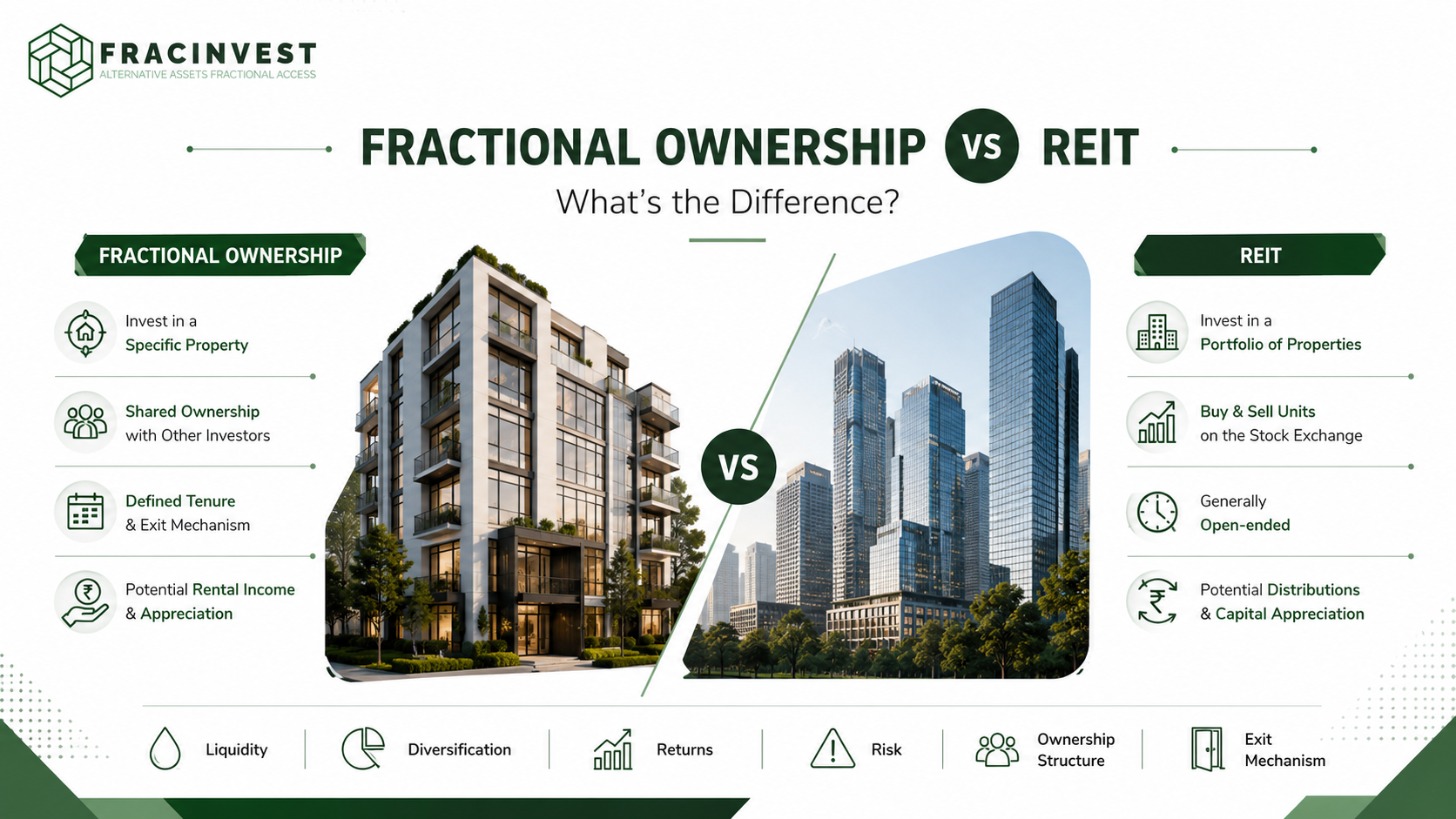
A REIT generally provides investors with exposure to a portfolio of real estate assets through REIT units. Fractional ownership, on the other hand, generally allows multiple investors to participate in a specific property or real estate opportunity through a structured ownership or investment arrangement.
So, which one is better?
There is no standard answer.
The right choice depends on what an investor is looking for in terms of diversification, liquidity, investment horizon, asset selection, risk and exit strategy.
What Is Fractional Ownership in Real Estate?
Fractional ownership is a model where multiple investors participate in the ownership or economic interest of a real estate asset or opportunity.
Instead of one investor purchasing the entire property, the investment is divided among multiple investors.
For example, consider a property valued at ₹5 crore.
Instead of a single investor committing the entire ₹5 crore, the opportunity can be structured so that multiple investors participate with smaller investment amounts.
The exact legal structure can vary. Depending on the opportunity, investors may participate through an SPV (Special Purpose Vehicle), LLP, company or another legally structured investment vehicle.
The important point is that the investor's investment is generally connected to a specific underlying real estate asset or project.
The potential return may come from rental income, appreciation, sale of the property or another defined investment mechanism depending on the structure.
What Does an Investor Evaluate in Fractional Ownership?
An investor generally needs to evaluate the underlying opportunity in detail, including:
- Location of the property
- Developer or asset owner
- Property valuation
- Acquisition price
- Rental potential
- Development potential
- Investment tenure
- Legal ownership structure
- Security structure, where applicable
- Expected return
- Costs and fees
- Exit mechanism
This makes fractional ownership more asset-specific compared with a portfolio-based investment such as a REIT.
What Is a REIT?
REIT stands for Real Estate Investment Trust.
A REIT pools capital from multiple investors and invests in only income-generating real estate assets according to its investment mandate.
Instead of an investor selecting and participating in a particular property, the investor buys units of the REIT and gets exposure to the REIT's underlying portfolio.
A REIT portfolio can include assets such as:
- Office buildings
- Shopping centres
- Warehouses
- Business parks
- Commercial complexes
- Other eligible income-generating real estate assets
One of the key attractions of listed REITs is that investors can generally buy and sell units through the stock market, subject to market liquidity and prevailing prices.
Therefore, REITs can offer investors a combination of real estate exposure and market-based liquidity.
Fractional Ownership vs REIT: The Key Difference
The simplest way to understand the difference is to look at the question an investor is answering.
With Fractional Ownership:
"Do I want to invest in this specific real estate opportunity?"
The investor evaluates the underlying property, structure, valuation, investment tenure and exit mechanism.
With a REIT:
"Do I want exposure to this REIT's real estate portfolio?"
The investor evaluates the REIT's portfolio, management, occupancy, tenants, financial performance, distributions, debt and market valuation.
Both approaches provide real estate exposure, but the nature of that exposure is different.
Fractional Ownership vs REIT: Comparison
| Factor | Fractional Ownership | REIT |
|---|---|---|
| Underlying exposure | Generally linked to a specific property or project | Exposure to a portfolio of real estate assets |
| Investment selection | Investor can evaluate specific opportunities | Investor invests in the REIT portfolio |
| Diversification | Usually more concentrated | Generally more diversified |
| Liquidity | Depends on the structure and exit mechanism | Listed REIT units can generally be traded on an exchange |
| Investment horizon | Often defined for a specific opportunity | Generally open-ended for listed REITs |
| Exit mechanism | Property sale, buyback, secondary transaction or other defined mechanism depending on structure | Sale of REIT units in the market |
| Pricing | Usually based on the underlying transaction or valuation | Market price of REIT units |
| Price volatility | Generally not continuously market-priced | Unit price can fluctuate daily |
| Asset selection | More targeted | Portfolio-level |
| Investor exposure | Specific property or structured opportunity | Indirect exposure through REIT units |
| Risk | More asset-specific | More portfolio and market-related |
| Entry amount | Depends on the opportunity | Generally accessible through REIT units |
| Income | Depends on property and investment structure | Distributions generated by the REIT |
| Capital appreciation | Linked largely to underlying property and investment structure | Linked to portfolio performance and market valuation |
1. Diversification
One of the biggest differences between the two models is diversification.
REITs
A REIT can hold multiple properties across locations, tenants and asset types.
This means an investor can obtain diversified real estate exposure through a single investment.
For investors who prefer portfolio diversification, this can be an important advantage.
Fractional Ownership
Fractional ownership is generally more concentrated because the investment may be linked to a particular property or project.
This means investors have the opportunity to specifically select the property they want to participate in.
However, concentration also means that the performance of the underlying property can have a significant impact on the investment outcome.
In simple terms:
REIT = Portfolio-level real estate exposure
Fractional Ownership = Targeted real estate exposure
2. Liquidity
Liquidity is one of the most important considerations when comparing the two.
Listed REIT units can generally be bought and sold through the stock market. This gives investors a market-based mechanism for entering or exiting their investment.
However, market liquidity does not mean that an investor will always receive the price they want. The market price can move depending on demand, interest rates, economic conditions, real estate performance and other factors.
Fractional ownership works differently.
The ability to exit depends on the specific structure and terms of the investment.
An exit could potentially involve:
- Sale of the underlying property
- Developer or sponsor buyback
- Secondary transaction
- Transfer of ownership interest
- Another predefined exit mechanism
Therefore, investors should not simply ask whether a fractional investment is liquid.
The more important question is:
"What is the planned exit mechanism for this investment?"
At FracInvest, we believe the exit strategy deserves to be evaluated before an investment decision is made, rather than only after the investment has been made.
3. Ownership and Investment Structure
The ownership structure is another important distinction.
When investing in a REIT, the investor purchases REIT units.
The investor does not generally select or directly own a specific office building, warehouse or shopping centre within the portfolio.
With fractional ownership, the structure can be more closely connected to a specific underlying property.
Depending on the opportunity, the investment may be structured through an SPV, LLP, company or another legally defined vehicle.
This makes it important for investors to understand exactly what they are investing in.
Before investing in any fractional real estate opportunity, investors should review the legal documentation and understand:
- Who owns the property?
- What rights does the investor receive?
- How is the investment structured?
- What security exists, if any?
- How are returns generated?
- What is the exit mechanism?
- What happens if the expected exit does not occur?
4. Returns
Returns from real estate investments can come from different sources.
For a REIT, investors may receive distributions generated from the underlying real estate portfolio. The value of the REIT units can also increase or decrease depending on market conditions and the performance of the underlying assets.
With fractional ownership, returns can depend on the specific property and the investment structure.
Potential sources of returns can include:
- Rental income
- Capital appreciation
- Property sale
- Structured return mechanisms, where applicable
This is why investors should not compare two real estate investments purely on the basis of a headline percentage.
A proper comparison should consider:
- Total return
- Investment tenure
- IRR (Internal Rate of Return)
- Income distribution
- Capital appreciation
- Fees
- Taxes
- Risk
- Liquidity
- Exit mechanism
A higher projected return can sometimes come with higher concentration or lower liquidity.
5. Risk
Neither REITs nor fractional ownership should be considered risk-free.
However, the nature of the risk can be different.
Risks Associated With Fractional Ownership
Depending on the structure, risks may include:
- Property-specific risk
- Developer or sponsor risk
- Valuation risk
- Concentration risk
- Construction or development risk
- Exit risk
- Liquidity risk
- Legal and structural risks
Risks Associated With REITs
REIT investors may be exposed to:
- Real estate market risk
- Market price volatility
- Interest rate risk
- Occupancy risk
- Tenant concentration
- Leverage
- Portfolio performance risk
- Management risk
Therefore, it is not accurate to simply say that one model is less risky than the other.
The better way to understand it is that the risks are distributed differently.
6. Investment Horizon
Fractional ownership opportunities often have a defined investment period.
For example, an opportunity may be structured around a 24-month, 36-month or another defined investment horizon.
The investor knows the intended investment period and the proposed exit mechanism before investing.
Listed REITs are different.
An investor can generally hold REIT units for as long as they choose and can potentially exit by selling their units in the market.
This makes REITs suitable for investors who prefer market-based liquidity and flexibility.
Fractional ownership may be more suitable for investors who are comfortable committing capital for a predefined period.
7. Asset Selection
This is one of the most interesting differences between the two investment models.
With a REIT, the investor is primarily evaluating the portfolio.
With fractional ownership, the investor can potentially evaluate the individual property.
For example, a fractional investor may look at:
| Location | Property | Developer | Valuation | Investment Structure | Exit |
|---|
A REIT investor may look at:
| REIT | Portfolio | Occupancy | Tenants | Leases | Debt | Distributions | Market Valuation |
|---|
Neither approach is inherently superior.
It simply represents a different investment philosophy.
A Simple Example
Suppose an investor has ₹20 lakh available for real estate investment.
Option 1: Invest in a REIT
The investor purchases REIT units worth ₹20 lakh.
The investment provides exposure to the REIT's portfolio.
The investor's return can come through distributions and changes in the market value of the REIT units.
The investor can generally buy or sell the units through the market.
Option 2: Fractional Ownership
The investor commits ₹20 lakh to a structured fractional real estate opportunity linked to a specific property.
The investor evaluates the property, valuation, investment structure, tenure and proposed exit mechanism.
The investment outcome depends on the performance of the underlying opportunity and the terms of the investment structure.
The key difference is clear.
The first investor buys exposure to a portfolio.
The second investor participates in a specific real estate opportunity.
Which Is Better: Fractional Ownership or REIT?
There is no single answer.
It depends on the investor's objectives.
REITs may be more suitable for investors who:
- Want diversified real estate exposure
- Prefer market-based liquidity
- Want to invest in a portfolio rather than one property
- Prefer exchange-traded investments
- Are comfortable with market price fluctuations
- Want flexibility around their investment horizon
Fractional Ownership may be more suitable for investors who:
- Want to evaluate specific real estate opportunities
- Prefer targeted asset exposure
- Are comfortable with a predefined investment period
- Want to understand the underlying property before investing
- Are willing to accept property-specific concentration
- Want to evaluate a defined exit strategy before investing
Can Investors Invest in Both?
Yes.
Investors do not necessarily have to choose one model exclusively.
REITs and fractional ownership can serve different purposes within a broader real estate allocation.
For example, an investor may use REITs for diversified and relatively liquid real estate exposure while considering selected fractional opportunities for targeted exposure to specific properties.
The important consideration is to understand the role each investment plays within the overall portfolio.
Why the Exit Strategy Matters in Fractional Ownership
One of the biggest questions investors often have about fractional real estate is liquidity.
However, liquidity should not be evaluated only after making an investment.
It should be considered at the beginning of the investment decision.
Before investing, an investor should ask:
What is the expected exit?
Who is responsible for the exit?
When is the investment expected to exit?
What happens if the expected exit is delayed?
Is there a contractual buyback or another defined mechanism?
What are the conditions attached to the exit?
At FracInvest, we believe that an investment opportunity should be evaluated not only on how investors enter, but also on how the investment is expected to exit.
This is particularly relevant when investing in structured fractional real estate opportunities with a defined investment tenure and exit mechanism.
What Should You Check Before Investing in Fractional Real Estate?
Before investing, investors should conduct their own due diligence and review the complete investment documentation.
Some important questions include:
1. What exactly am I investing in?
Understand whether you are acquiring ownership, units, partnership interest, securities or another form of economic interest.
2. Who owns the underlying property?
Verify the ownership and title structure.
3. How is the property valued?
Understand the purchase price, valuation methodology and underlying assumptions.
4. What is the investment tenure?
Know how long your capital is expected to remain invested.
5. How are returns generated?
Understand whether the expected return comes from rental income, appreciation, property sale or another mechanism.
6. What is the exit mechanism?
This is one of the most important questions.
7. What are the risks?
Understand property-specific, developer, market, legal, liquidity and execution risks.
8. What are the fees and costs?
Review all platform, transaction, management, legal and other applicable costs.
9. What documentation will I receive?
Review agreements, disclosures, property documents and investment terms before committing capital.
Fractional Ownership vs REIT: The Bottom Line
Both REITs and fractional ownership have made real estate investment more accessible to investors.
However, they provide exposure to real estate in fundamentally different ways.
REITs generally provide diversified, portfolio-level exposure with market-based liquidity.
Fractional ownership generally provides more targeted exposure to a specific property or structured real estate opportunity, with liquidity and exit dependent on the specific investment structure.
For investors, the question should not simply be:
"Which one gives higher returns?"
A better question is:
"Which investment structure fits my investment objective, risk appetite, liquidity requirement and investment horizon?"
At FracInvest, our focus is on creating access to structured fractional real estate investment opportunities where investors can evaluate the underlying asset, investment structure, tenure, expected returns and proposed exit mechanism before making an investment decision.
Because in real estate investing, understanding where your money is going and how it is expected to come back can be just as important as the potential return.
Frequently Asked Questions
Is fractional ownership the same as a REIT?
No. Fractional ownership and REITs are different investment structures. Fractional ownership generally provides exposure to a specific property or real estate opportunity, while a REIT provides exposure to a portfolio of real estate assets through REIT units.
Is fractional ownership more profitable than REITs?
There is no guaranteed answer. Returns depend on the specific investment, property performance, structure, fees, market conditions and exit value. Investors should compare total return, risk, tenure and liquidity rather than headline returns alone.
Is fractional real estate investment liquid?
Liquidity depends on the specific structure and exit mechanism. Some opportunities may have a defined exit, buyback arrangement or secondary transaction mechanism, while others may require a property sale.
Are REITs more liquid than fractional ownership?
Listed REITs generally offer greater market-based liquidity because their units can be traded on an exchange. Fractional investments may have more limited liquidity depending on their structure and exit mechanism.
Which is more diversified, REITs or fractional ownership?
REITs generally provide greater diversification because investors receive exposure to a portfolio of properties. Fractional ownership is generally more concentrated because the investment may be linked to a specific property or project.
Can I invest in both REITs and fractional ownership?
Yes. The two models can serve different investment objectives. An investor can consider both depending on their portfolio allocation, risk appetite, liquidity requirements and investment horizon.
What should I check before investing in fractional ownership?
Investors should understand the legal structure, underlying property, valuation, investment tenure, return mechanism, risks, fees, security structure where applicable and most importantly, the proposed exit mechanism.