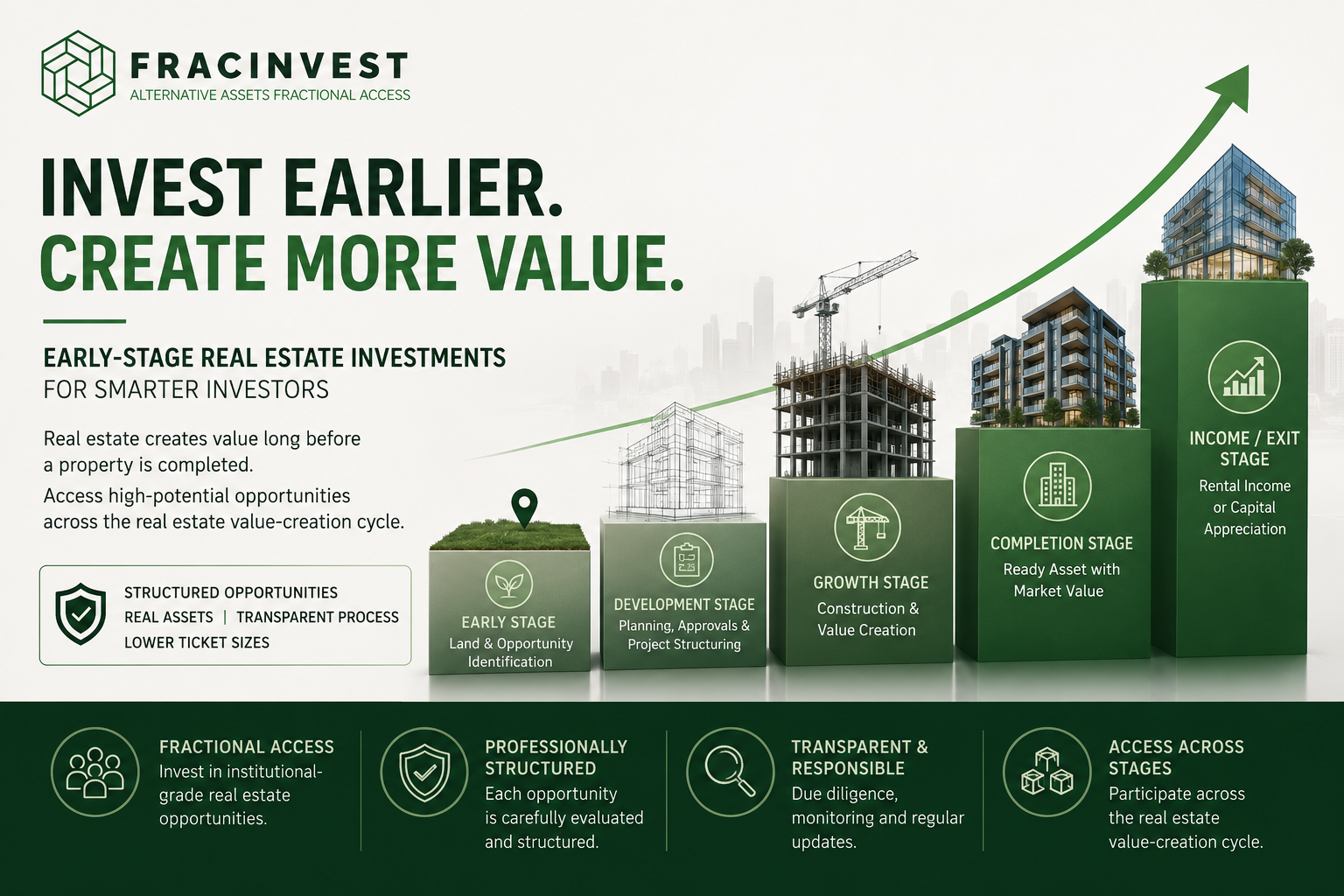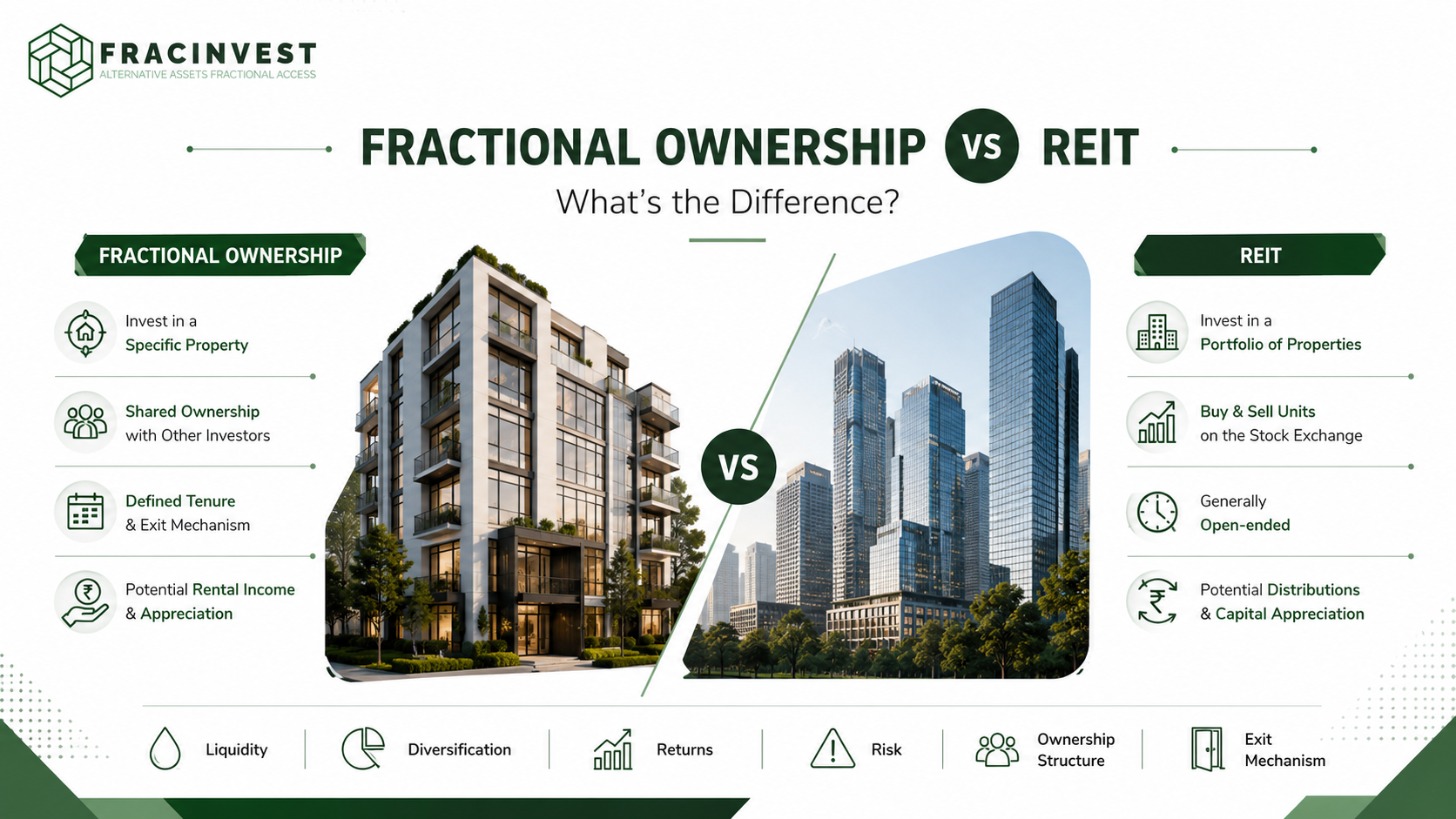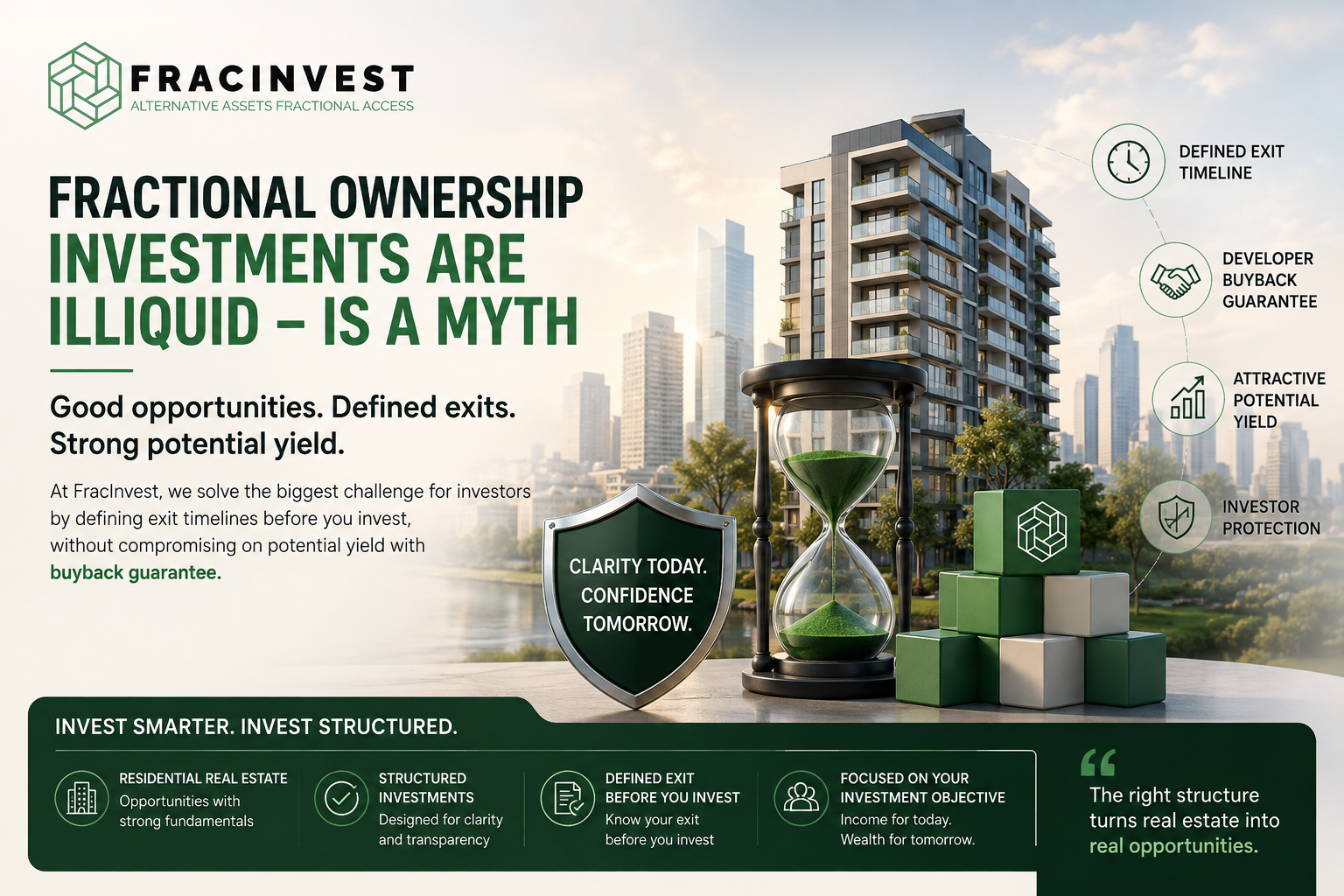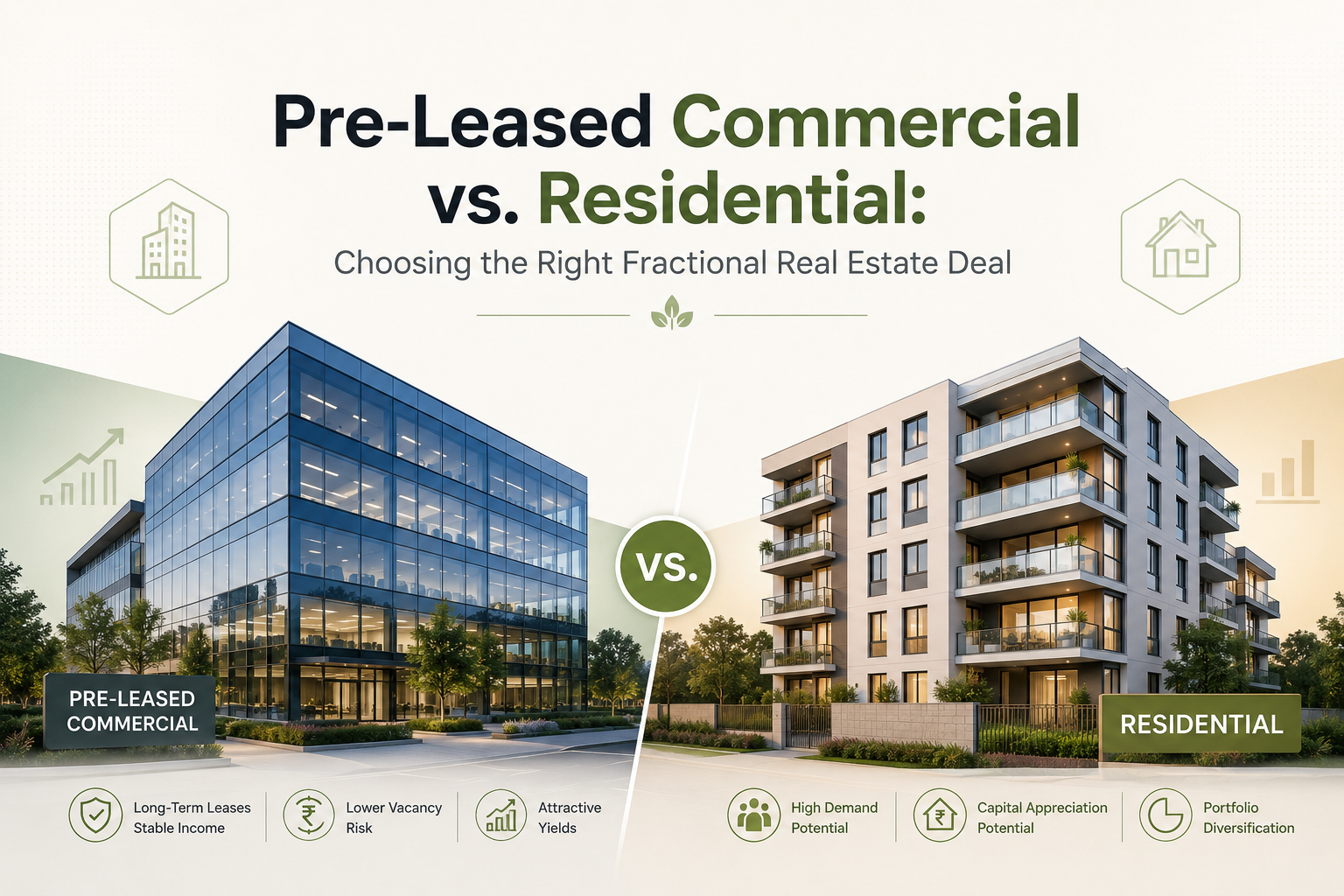
What if you found a ₹2 crore property that looked like a good investment, but you didn't want to put ₹2 crore into a single asset or take on a large home loan?
That's where fractional ownership becomes interesting.
Instead of buying the entire property yourself, you invest a smaller amount and participate in a larger real estate opportunity along with other investors.
But why choose fractional ownership when you could simply buy a property?
Both give you exposure to real estate. The difference is in how much capital you commit, how much control you have, how the investment is managed and how you eventually exit.
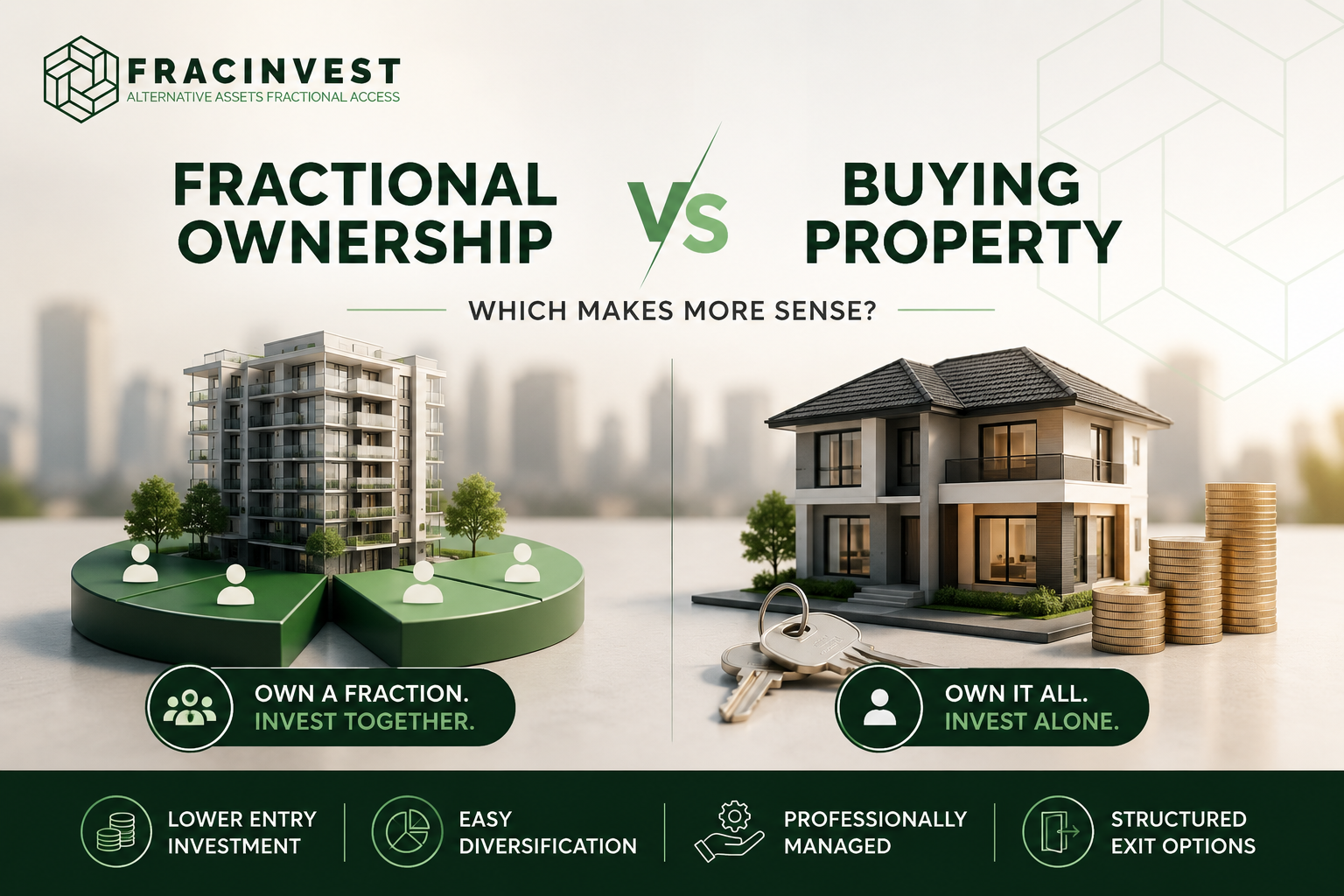
Here's a practical comparison of fractional ownership vs buying property.
What is fractional ownership?
The idea is fairly simple.
Multiple investors pool their capital to participate in a real estate investment. Instead of one person funding the entire property, each investor participates with a smaller investment amount based on the structure of the opportunity.
Say a real estate opportunity requires ₹10 crore.
One investor does not necessarily have to invest the entire ₹10 crore. The investment can be structured across multiple investors with smaller ticket sizes.
An investor with ₹20 lakh or ₹50 lakh can therefore potentially participate in a real estate opportunity that would otherwise require substantially more capital.
That's the basic appeal.
You get real estate exposure without having to buy the whole property yourself.
If you're new to the concept, read our guide on how fractional ownership works in India.
How is that different from buying a property?
When you buy a property directly, the entire property belongs to you.
You decide whether to hold it, rent it, renovate it or sell it.
That level of control is valuable.
But it also means you need to arrange the entire purchase consideration through your own capital, a loan or a combination of both.
Then there are other costs to consider, including stamp duty, registration, loan interest, maintenance and property taxes.
And when you eventually want to exit, finding a buyer is your responsibility.
Fractional ownership approaches real estate differently.
Instead of asking:
"Which property can I afford to buy?"
you're asking:
"Which real estate opportunity do I want to invest in?"
That distinction becomes particularly relevant when your objective is investment rather than personal use.
Fractional Ownership vs Buying Property
| Factor | Fractional Ownership | Buying Property |
|---|---|---|
| Capital Required | Usually lower | Usually higher |
| Ownership | Shared or structured interest | Complete ownership |
| Control | Limited | High |
| Property Management | Generally professionally managed | Owner's responsibility |
| Diversification | Easier with available capital | More difficult |
| Personal Use | Usually not the objective | Possible |
| Financing | Depends on structure | Home loans available |
| Exit | Depends on investment structure | Owner finds buyer |
| Investor Effort | Relatively lower | Relatively higher |
Suppose you have ₹20 lakh to invest
This is where the comparison becomes more practical.
Imagine you have ₹20 lakh available for real estate investment.
Option 1: Buy a property
In a city like Bengaluru, ₹20 lakh may not be enough to buy the type of property or location you actually want.
So you might use it as a down payment.
You could buy a ₹1 crore property, finance the remaining amount and start paying EMIs.
Your ₹20 lakh investment has now become a much larger financial commitment.
Along with the loan, there may be stamp duty, registration, maintenance and other expenses.
And most of your real estate exposure is concentrated in one property.
Option 2: Fractional ownership
Instead of using ₹20 lakh as a down payment, you could potentially invest it into a larger fractional real estate opportunity.
You do not own the entire property.
But you also do not need to fund the entire purchase.
For someone investing in real estate primarily for returns rather than personal use, that can be an important difference.
Fractional ownership can make capital more efficient
One of the biggest challenges with traditional property investing is simple:
Good properties can require a lot of capital.
You may find an attractive project in a strong location, but the investment required could be ₹1 crore, ₹2 crore or even more.
Buying that property means putting a significant amount of capital into a single asset.
Fractional ownership can lower the entry point.
Instead of asking whether you can afford the whole property, you can evaluate the investment opportunity and participate at the available ticket size.
That can leave you with capital available for other investments rather than concentrating everything in one property.
Diversification becomes easier
Consider an investor with ₹1 crore allocated to real estate.
One option is to buy a single ₹1 crore property.
The investor's outcome then depends heavily on:
- one property
- one developer
- one location
- one market
- one exit
With smaller fractional investment amounts, the same investor may potentially spread capital across multiple opportunities.
For example:
₹25 lakh in Opportunity A ₹25 lakh in Opportunity B ₹25 lakh in Opportunity C ₹25 lakh in Opportunity D
Diversification does not eliminate risk.
But it can reduce your dependence on the performance of one individual property.
Where buying property clearly wins: control
Fractional ownership is not better at everything.
If having complete control over the property matters to you, direct ownership wins.
When you own the entire property, you decide what happens.
Want to sell it?
Your decision.
Want to hold it for another five years?
Your decision.
Want to rent it out?
Again, your decision.
With fractional ownership, decisions such as the investment tenure and exit are generally governed by the investment structure and agreements.
That means investors need to understand exactly what rights they have before investing.
Fractional ownership can be more hands-off
Anyone who has owned an investment property knows that real estate isn't always passive.
There can be paperwork, maintenance, tenants, repairs, association matters, taxes and rent collection.
Then, when you want to sell, there are brokers, negotiations and buyers to deal with.
Some investors are perfectly comfortable managing all of this.
Others would rather have the investment professionally managed.
Fractional ownership structures are generally designed to reduce this operational burden.
For busy professionals, entrepreneurs and investors, that can be a meaningful advantage.
The exit matters as much as the entry
When people evaluate property investments, they naturally focus on the purchase price and expected return.
But there is another question that deserves just as much attention:
How do I get my money back?
With a directly owned property, you need to find a buyer willing to purchase it at an acceptable price.
Fractional ownership does not automatically make real estate liquid either.
The exit depends on how the investment is structured.
Some opportunities may have a defined investment tenure or planned exit mechanism. Others may depend on selling the underlying asset or finding another investor.
Before investing, ask two questions:
What is the exit plan?
What happens if the planned exit is delayed?
You can read more about this in our guide to fractional ownership exit strategies.
Don't compare only headline returns
Suppose a property is expected to appreciate by 30%.
That sounds attractive.
But 30% property appreciation does not necessarily mean a 30% return in your pocket.
With direct ownership, your actual return needs to consider:
Property appreciation + rental income - interest - taxes - maintenance - transaction costs
With fractional ownership, you need to consider:
Distributions + exit proceeds - fees - expenses - applicable taxes
The better comparison is therefore not simply:
"Which one offers the higher percentage?"
It is:
"How much capital did I invest, what risks did I take and how much money did I actually receive back?"
Projected or targeted returns should also never be treated as guaranteed returns.
So, which one makes more sense?
It depends on what you want from real estate.
Buying property may make more sense if you want complete ownership, personal use, full control over the asset and the freedom to decide when to sell or rent.
Fractional ownership may make more sense if you're approaching real estate primarily as an investment, want a lower entry amount, prefer professional management or want to spread your capital across multiple opportunities.
Neither option is universally better.
They solve different problems.
A simple way to think about the difference is:
Buying property is about owning the whole asset.
Fractional ownership is about participating in the investment opportunity.
Your choice should ultimately depend on your available capital, investment horizon, risk appetite, liquidity requirements and desired level of control.
Exploring Fractional Real Estate with FracInvest
At FracInvest, we focus on making selected real estate investment opportunities accessible without requiring investors to purchase an entire property themselves.
But accessibility is only one part of the decision.
Before investing, understand the underlying property, investment structure, developer or counterparty, projected returns, associated risks and exit mechanism.
Because a good real estate investment should start with understanding the opportunity, not just looking at the return percentage.
Disclaimer: This article is for informational and educational purposes only and does not constitute investment, legal or tax advice. Real estate investments involve market, liquidity, legal, project and counterparty risks. Projected or targeted returns are not guaranteed.