
Most investment portfolios eventually start looking quite similar.
There are mutual funds and equities for long-term growth. Fixed deposits, bonds and debt instruments bring relative stability. There may be some gold. And for many Indian families, there is already a house somewhere in the portfolio.
So when someone talks about portfolio diversification, the natural question is: what else do you really need?
At FracInvest, we think there is an interesting space between traditional financial investments and conventional property ownership: structured real estate opportunities where the underlying asset, investment tenure and intended exit are identified at the beginning.
It isn't a replacement for mutual funds or fixed income. It can simply be another bucket. And for investors who already have a reasonably diversified financial portfolio, that distinction is worth understanding.
The Problem With Looking Only at Asset Classes
Diversification is often explained as spreading money across equity, debt, gold and real estate. That's correct, but incomplete.
Two investments belonging to the same asset class can behave very differently.
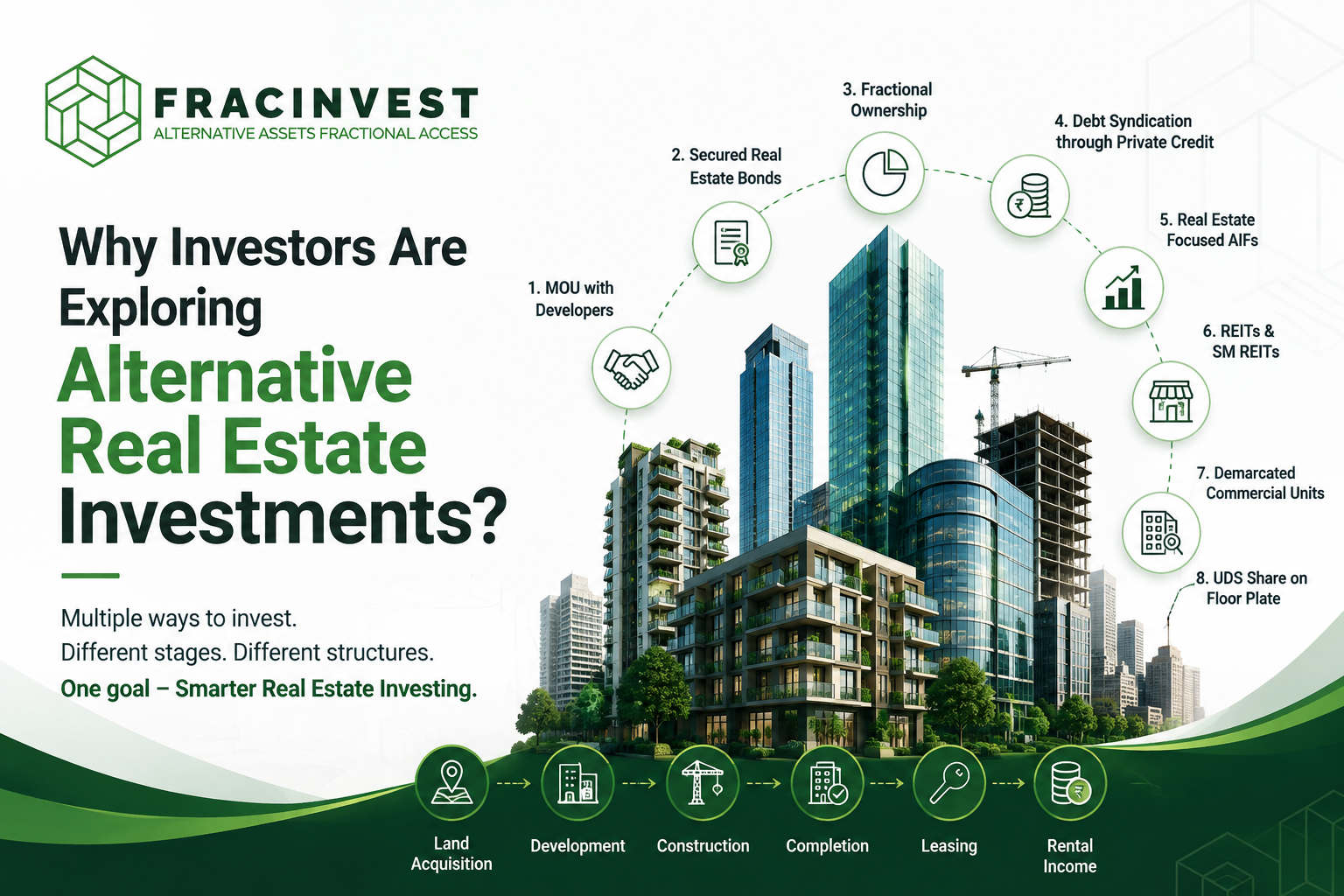
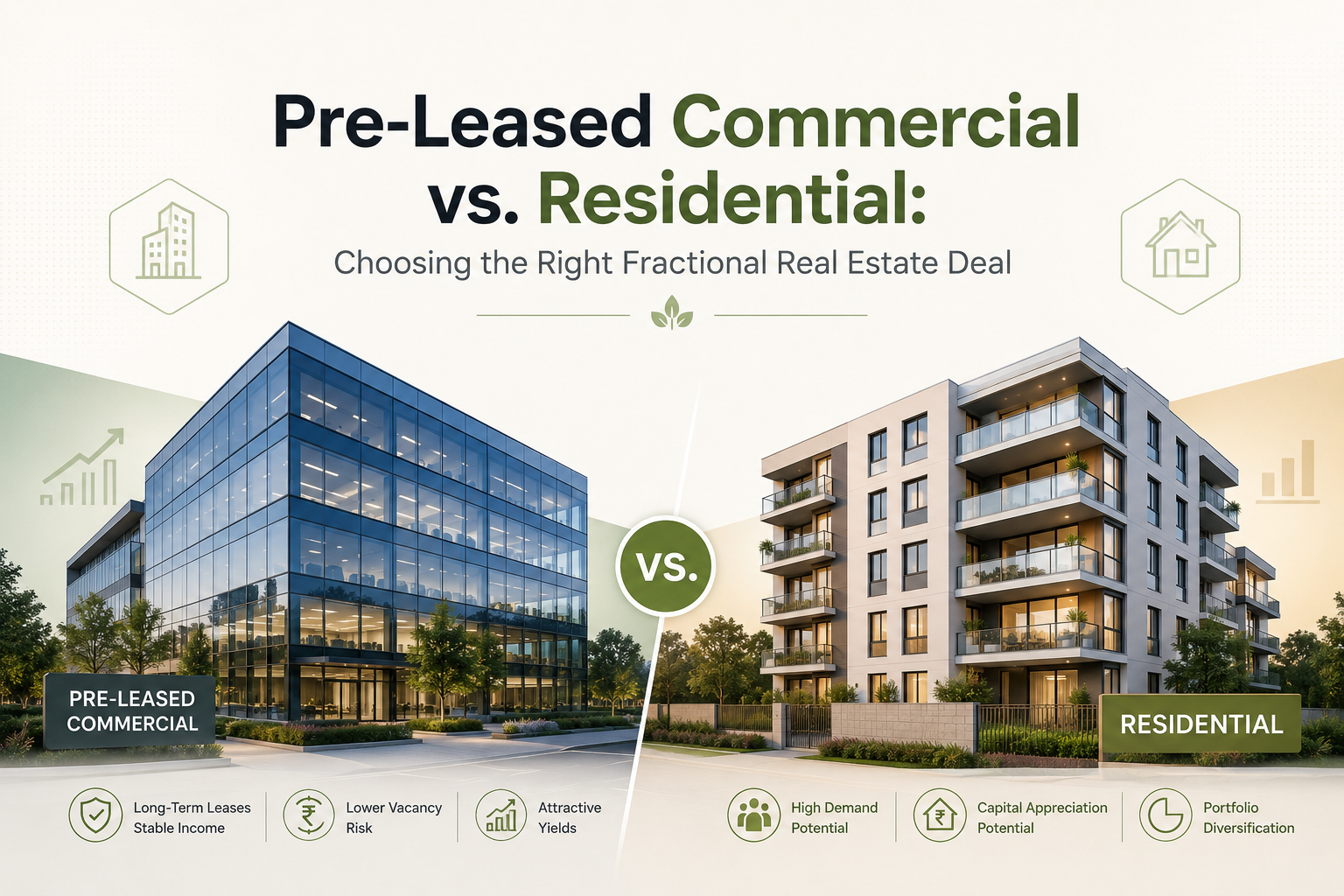
Buying a completed apartment for rental income is one form of real estate investing. Buying land and waiting ten years for development is another. Entering an early-stage residential project at an attractive valuation with a predefined 24-month holding period and a contractual developer buyback is a very different proposition again.
All three are technically real estate. But the risk, liquidity, return expectation and exit strategy can be completely different.
That's why we believe investors should look not only at what asset they own, but also at how the investment is structured.
For a broader introduction to this approach, you can read What Is Fractional Real Estate Investing? and How Fractional Real Estate Investment Works in India.
Where Does Defined-Exit Real Estate Fit?
Think about a typical portfolio.
Equities can provide long-term capital appreciation, but values move with the market.
Fixed deposits and bonds can provide more predictable cash flows, but expected returns are generally lower.
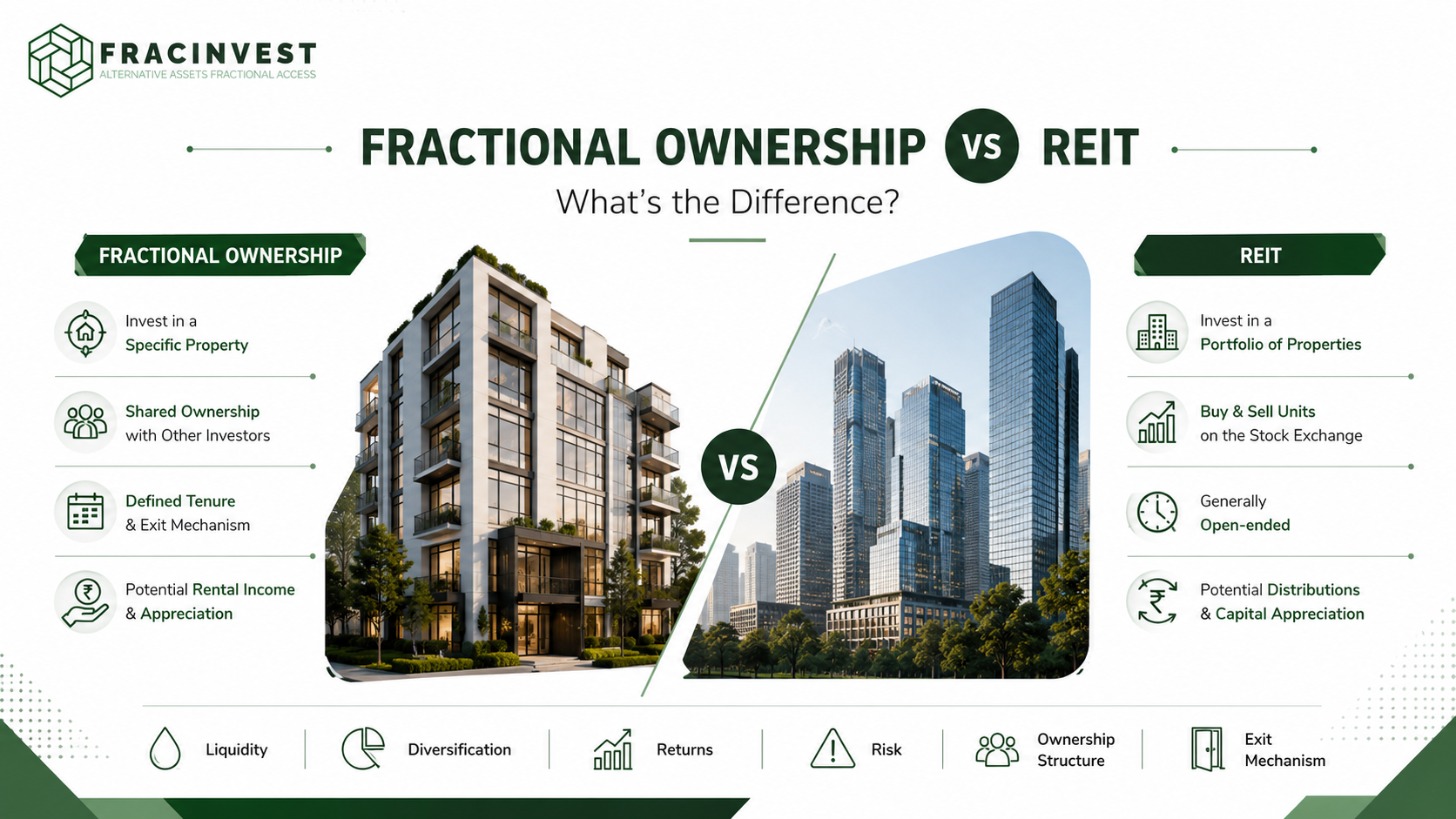
Traditional real estate provides exposure to a physical asset, but usually requires significant capital and can be difficult to exit quickly.
Structured real estate attempts to approach some of these issues differently.
Instead of buying an entire property and deciding how to sell it several years later, the transaction can be evaluated from entry to exit:
Underlying Property -> Entry Valuation -> Defined Tenure -> Security -> Intended Exit
That last part matters.
In traditional property investing, the exit is often an afterthought. You buy today and hope there will be a buyer at the right price when you eventually want to sell.
In a defined-exit opportunity, the intended liquidity mechanism can be considered before the investment is made. That doesn't make the exit guaranteed, but it does make the investment easier to evaluate as a complete transaction.
You can also explore How to Evaluate a Fractional Real Estate Investment before comparing any opportunity with other asset classes.
Let's Put ₹20 Lakh Into an Example
Numbers make this easier to understand.
Suppose an investor participates with ₹20 lakh in a structured residential real estate opportunity.
Assume the opportunity has a 24-month tenure and targets a return equivalent to approximately 18% per annum, or 36% over the two-year period on a simple-return basis.
The illustration would look like this:
| 24-Month Illustration | Amount |
|---|---|
| Initial participation | ₹20.00 lakh |
| Target gross return | 36% |
| Target gross profit | ₹7.20 lakh |
| Illustrative tax at 34.9% on profit | ₹2.51 lakh |
| Illustrative post-tax profit | ₹4.69 lakh |
| Illustrative amount after tax | ₹24.69 lakh |
| Cumulative post-tax return | ~23.4% |
So even after applying an illustrative 34.9% tax at the LLP level to the profit, ₹20 lakh could correspond to approximately ₹24.69 lakh after 24 months if the targeted gross return is achieved and the assumed tax treatment applies.
That is approximately 23.4% cumulative post-tax return over two years. This is where the comparison with conventional fixed-income investments becomes interesting.
Don't Compare 18% With an FD Rate. Compare What You Actually Keep.
Investors frequently compare opportunities using headline rates.
An FD might advertise one interest rate. A bond may have a coupon rate. A real estate opportunity may have a targeted IRR or total return.
But those numbers don't necessarily tell you what ends up in your account.
The more useful question is:
"What is my return after tax?"
Interest from a bank fixed deposit is generally taxable at the investor's applicable income-tax rate. For someone in a higher tax bracket, the difference between the advertised FD rate and the amount retained after tax can be meaningful.
The same principle applies to bonds and other fixed-income products, although taxation varies depending on the instrument.
That is why the comparison should ideally be:
Post-tax return vs post-tax return
rather than:
Headline return vs headline return
For our structured real estate illustration, the relevant number isn't simply 36% over 24 months. It is approximately 23.4% cumulative after the assumed LLP-level tax, subject to the actual transaction structure and tax treatment.
For more context, see Fractional Real Estate vs Traditional Real Estate Investment.
But Isn't Fixed Income Much Safer?
This is where comparisons need to remain sensible.
A structured real estate opportunity targeting a higher return should not be presented as equivalent to a bank FD or a high-quality fixed-income instrument. They have different risks.
A fixed deposit primarily exposes you to the financial institution, subject to the applicable regulatory and deposit-insurance framework.
A bond exposes you to the issuer's creditworthiness, interest-rate environment and liquidity, among other risks.
A structured real estate transaction can involve property risk, developer repayment and execution risk, construction risk, legal risk and exit risk.
The higher targeted return exists partly because the investor is accepting a different set of risks.
The question is therefore not:
"Why would anyone invest in fixed income if real estate gives more?"
The better question is:
"Am I being adequately compensated for the additional risk I am taking?"
That's a much healthier way to evaluate any alternative investment.
Before investing, it is also important to understand the risks of fractional real estate investing, including liquidity, documentation, valuation and execution risks.
Why the Underlying Real Estate Matters
One thing we particularly like about structured residential real estate is that there is an identifiable underlying asset.
But simply saying an investment is "secured by real estate" isn't enough.
Investors should understand what the underlying property is, how it has been valued, what stage the project is at, whether the title and approvals have been independently reviewed, whether there are existing charges over the asset and what rights investors actually have if the planned exit doesn't happen.
This is why FracInvest's approach starts with the real estate itself, not the advertised return.
A weak project doesn't suddenly become a strong investment because someone adds a buyback agreement.
For a practical due-diligence framework, read Due Diligence Checklist for Real Estate Investments.
Defined Exit Is Equally Important
Traditional real estate has one obvious disadvantage for an investment portfolio: liquidity.
You cannot normally click a button and sell an apartment tomorrow.
A predefined exit structure attempts to address this differently.
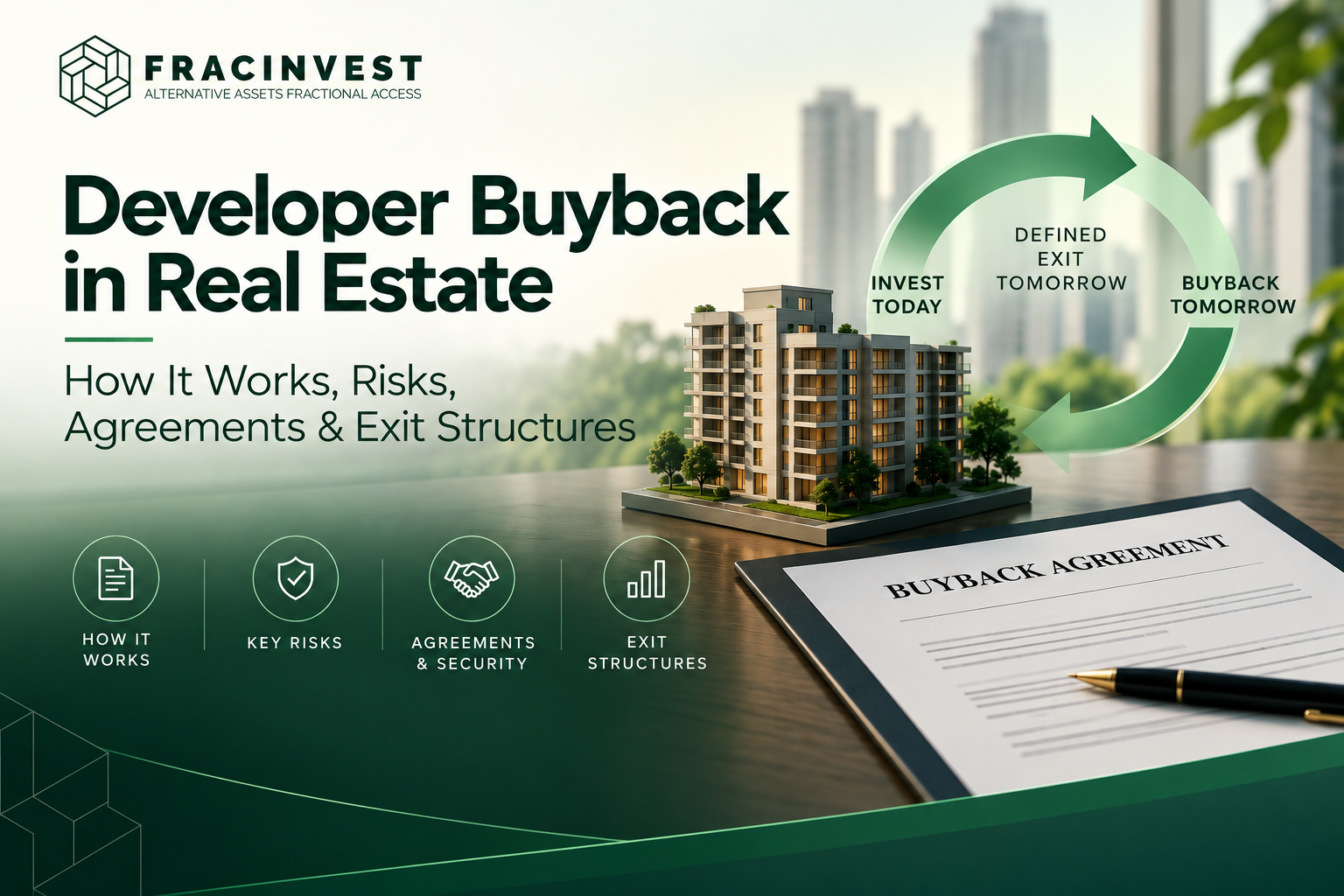
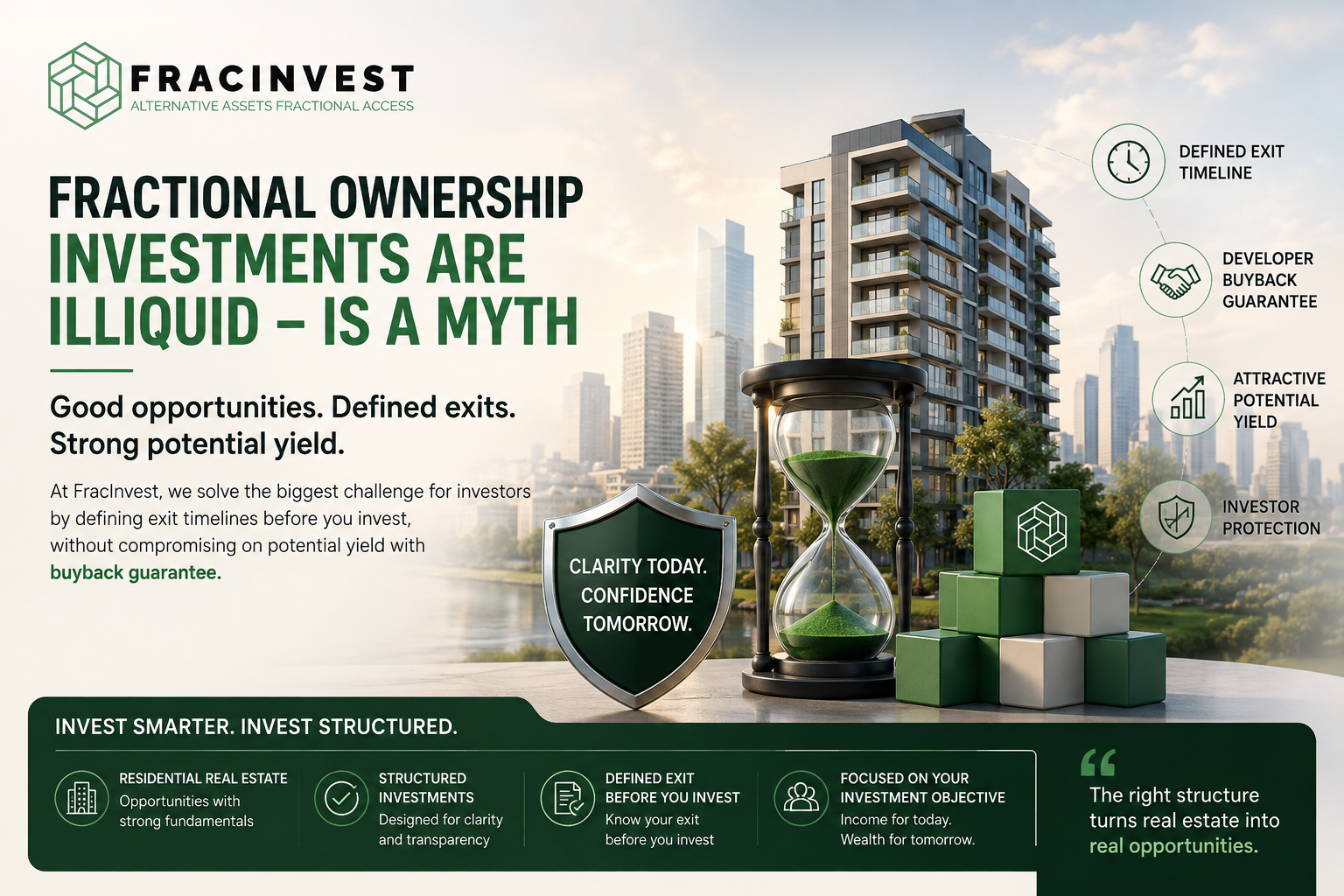
For example, an early-stage residential transaction may have a defined 24-month holding period, with a developer buyback forming the intended exit mechanism.
Instead of:
Buy -> Hold -> Search for Buyer -> Negotiate -> Sell
the intended structure becomes:
Buy -> Defined Holding Period -> Contractual Exit Mechanism
That creates more visibility around the expected investment lifecycle.
But we deliberately use the words "intended" and "defined", rather than "guaranteed."
A developer buyback is only as strong as the developer's ability to honour it, the agreement supporting it, the security available and the remedies if the obligation isn't fulfilled.
That's why due diligence on the exit is just as important as due diligence on the property.
You can learn more about this distinction in Understanding Exit Strategies in Fractional Real Estate.
So Where Could FracInvest Fit in a Portfolio?
Imagine an investor already has substantial exposure to equity mutual funds, some fixed deposits or bonds, perhaps gold and a self-occupied home.
The next ₹20 lakh doesn't necessarily need to go into more of the same.
A structured real estate opportunity could potentially add exposure to:
A physical underlying asset
A different return driver from listed equity markets
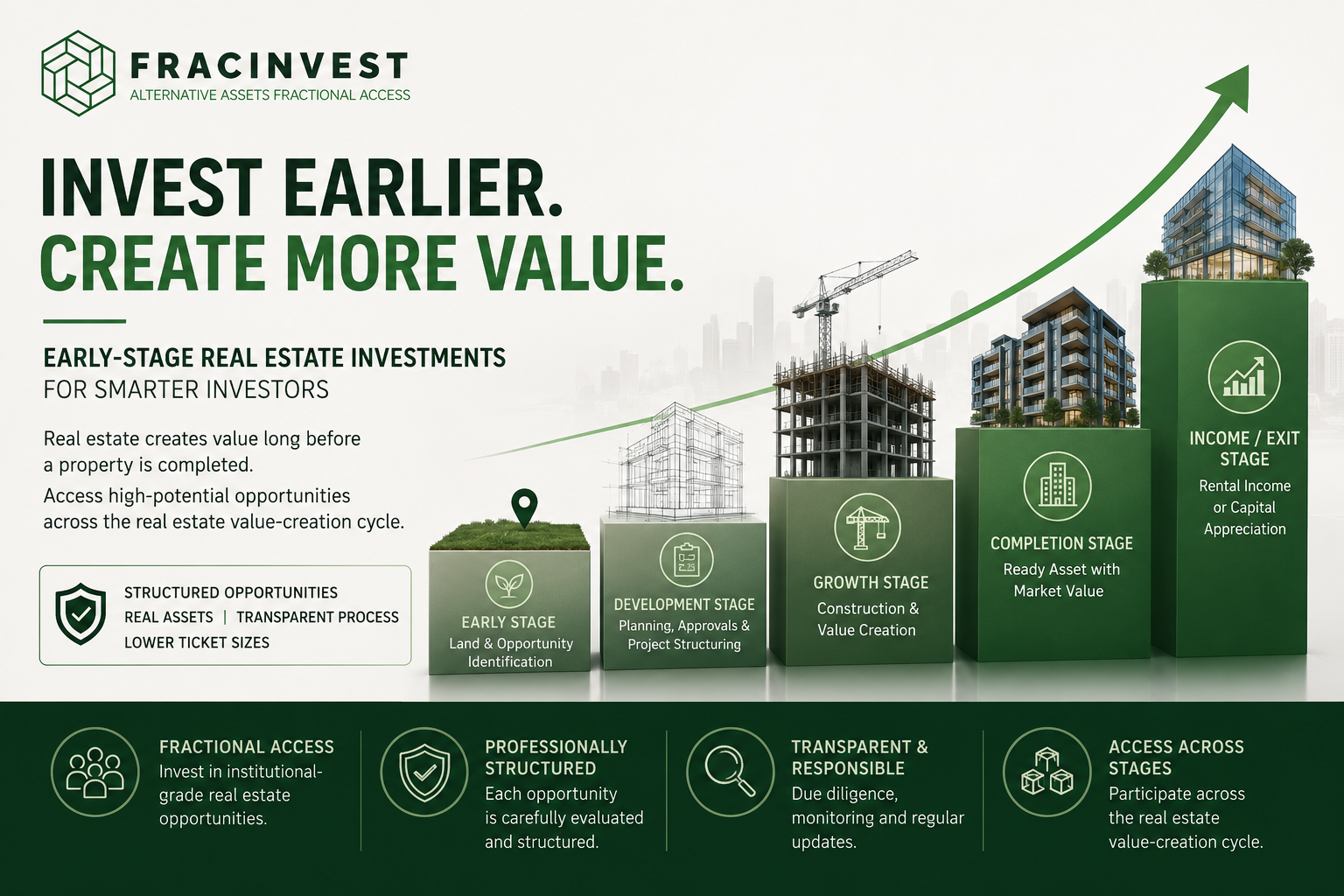
Early-stage property value creation
A predefined investment tenure
An intended contractual exit mechanism
That is diversification at the investment-structure level, not merely the asset-class level.
It also means the allocation should be proportionate.
Someone with ₹20 lakh of total investible wealth should think very differently from someone with a ₹2 crore or ₹5 crore diversified portfolio who wants to allocate a portion towards alternative assets.
Alternative investments should complement a portfolio, not overwhelm it.
For a broader comparison of investment approaches, see Why Investors Consider Fractional Ownership in Real Estate.
Why FracInvest Starts From ₹20 Lakh
One of the traditional barriers to real estate diversification has always been ticket size.
A quality residential unit in Bangalore can easily require a commitment of ₹1 crore or more. That creates concentration.
If an investor has ₹1.5 crore of investible capital and puts ₹1 crore into one apartment, that isn't necessarily diversification simply because the asset happens to be real estate.
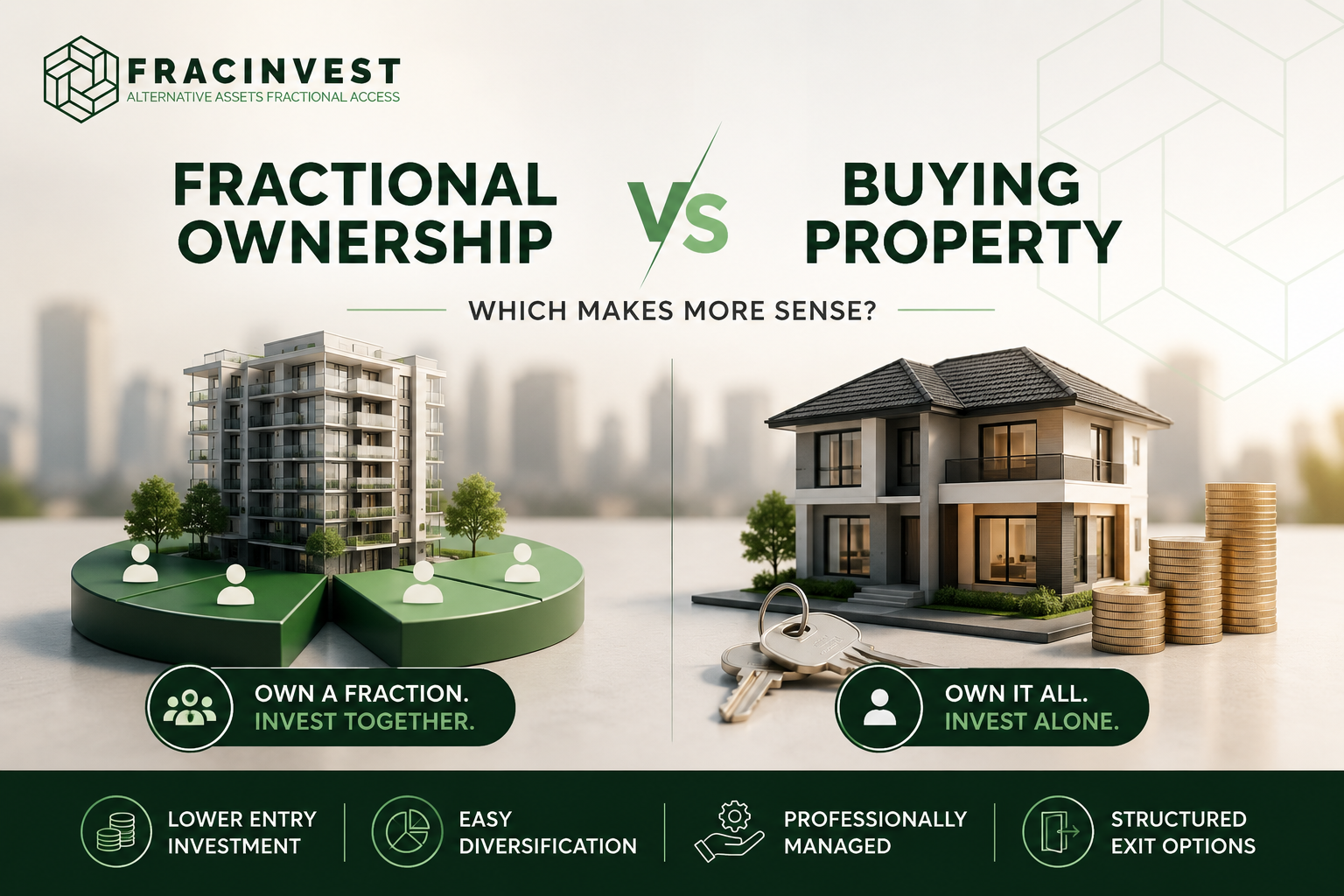
Structured fractional participation can reduce that problem.
At FracInvest, selected opportunities can be accessed from ₹20 lakh onwards, allowing investors to consider real estate exposure without necessarily purchasing an entire property.
The objective isn't merely to make the ticket smaller. The larger idea is to structure the complete lifecycle:
Entry -> Ownership -> Security -> Holding Period -> Exit
To understand the broader model, read Fractional Ownership in Real Estate: Benefits and Considerations.
Return Matters. Structure Matters More.
A targeted 18% annual return naturally gets attention.
But we don't think that should be the first number an investor looks at.
Before return comes a more important set of questions.
What property am I participating in?
At what valuation are we entering?
Who is the developer?
What supports my capital?
How long is the tenure?
How is the exit supposed to happen?
And what happens if that exit doesn't happen on time?
Only after understanding those answers does the targeted return become meaningful.
Because a high return without a sensible structure is simply a high number.
For additional guidance, see Questions to Ask Before Investing in Fractional Real Estate.
The Bigger Portfolio Question
Portfolio diversification isn't about finding one investment that does everything.
Equities don't need to behave like fixed deposits. Fixed deposits don't need to deliver equity-like returns. And structured real estate doesn't need to replace either of them.
Each can serve a different purpose.
For investors who already have traditional equity and fixed-income exposure, defined-exit real estate can be worth evaluating as an additional portfolio allocation, particularly when the underlying property, entry valuation, developer quality, security and exit structure can all be assessed upfront.
At FracInvest, that's the space we're trying to make more accessible.
Not real estate simply because it is real estate.
But selected real estate opportunities structured around entry, ownership and exit, with participation starting from ₹20 lakh onwards.
Investors interested in understanding how these transactions work can explore FracInvest's current opportunities and evaluate the underlying property, structure, risks and exit mechanism for themselves.
Final Thought
If you already own mutual funds, fixed income and perhaps a home, diversification doesn't necessarily mean adding another mutual fund or another FD.
Sometimes it means adding an asset whose return is driven by something different.
Structured real estate can potentially provide that.
But the reason to consider it shouldn't simply be "18% is higher than 8%."
It should be because the underlying asset, risk, post-tax return, tenure and exit structure make sense within your overall portfolio.
That's a much better starting point for any investment decision.
Disclaimer: This article is for educational purposes only and does not constitute investment, tax, legal or financial advice. The ₹20 lakh illustration assumes a targeted gross return of 36% over 24 months and applies an illustrative 34.9% tax to the resulting profit solely to demonstrate the effect of taxation. Actual tax treatment depends on the transaction structure, applicable tax laws and investor circumstances. Targeted returns and developer buyback arrangements are not assured or guaranteed. Investors should independently review the underlying property, legal documentation, taxation, security structure and risks before participating.